Tungsten ring sizing guide: get the fit right before you buy
For a tungsten carbide ring, use a physical sizer that matches the finished band’s width and inside profile, test it on the intended finger on at least two ordinary days, and confirm the seller’s exact size scale. Conventional tungsten carbide bands generally are not resized by cutting and rejoining; the practical remedy may be exchange or replacement, so read the seller’s size-exchange, remake and engraving terms before ordering.
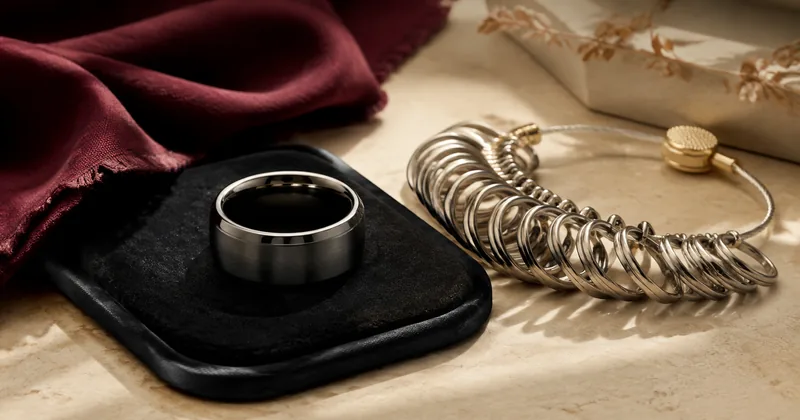
A tungsten ring sizing guide needs to start before checkout. Conventional tungsten carbide bands are not handled with the cut-and-join resizing used for many precious-metal bands. If the fit is wrong, the practical remedy may be a size exchange or a newly made ring. That makes the exact band geometry and the seller’s written policy part of the sizing decision, not paperwork to read after the ring arrives.
The word “tungsten” covers products with different widths, interiors, finishes and inlays. Do not transfer a size from another ring just because both are described as tungsten, and do not accept a generic rule that every comfort-fit band needs the same correction. Measure the intended finger, test a representative sample and make the retailer confirm how this particular model is handled.
Why does accurate sizing matter more for a tungsten carbide ring?
Many conventional tungsten carbide rings cannot be stretched, compressed, cut and rejoined through the familiar precious-metal resizing process. GIA’s overview of ring materials for everyday wear lists tungsten as not resizable. Seller policies still differ, but the purchase risk is the same: a fit change may require a different ring rather than an altered shank.
Replacement has consequences. The same style or finish may no longer be available later. An inlay, engraving or personalised interior may need to be recreated, and a new ring can differ slightly in colour or pattern. A “lifetime sizing” promise may mean exchanging the original for another item, not changing the piece you own. Sentimental continuity therefore needs to be considered before the purchase.
This does not mean tungsten is impossible to buy accurately. It means the measurement and trial deserve the same attention as the material and finish. A returnable sample or exact-model try-on usually provides better evidence than any rule based only on a size chart.
Does tungsten use a different ring-size scale?
Tungsten carbide does not create a separate national sizing system. A seller may label the ring in US numbers, UK letters, European circumference values or another standard, just as it would for other materials. The physical fit still comes from the inside geometry. What can differ is the seller’s manufacturing tolerance, available increments and interpretation of the size label.
Ask whether the model is offered in whole, half or quarter sizes and whether its published chart represents inside diameter or circumference. Keep your original millimetre reading when using the ring-size converter, because repeated conversion and rounding can move a borderline value. Send the unrounded result and the requested displayed size to the seller if there is any ambiguity.
Do not assume two brands’ size 10 rings are physically identical. Nor should you infer size from the outside diameter of a thick tungsten band. Only the internal opening determines the ring’s basic size, while the width and inner contour influence how that opening feels on the hand.
How should you measure before ordering a tungsten ring?
Start with a professional gauge or a reliable plastic sizer on the exact finger and hand that will wear the ring. Take readings on at least two ordinary days when the hand is comfortably warm and not temporarily changed by hard exercise, cold exposure or unusual swelling. The sizer should pass the knuckle with gentle resistance and sit securely at the base. Record the result before rounding.
GIA’s benchmark for accurate finger and ring sizing recommends narrow gauges for narrow bands and wide gauges for rings wider than 4 mm. It also says a correct fit should pass the joint and settle where the ring will be worn. Follow that geometry rather than measuring only the finger base. The finger measurement guide gives a repeatable home method when a gauge is not immediately available.
Record the gauge width and inside profile alongside the size. If the retailer offers a mailed kit, check whether its rings resemble the ordered band’s width and whether it uses that retailer’s own size scale. Keep photographs and notes from the test until the finished ring has passed inspection.
How do band width and inside profile affect a tungsten fit?
Width often matters more to feel than material. A broad band contacts more of the finger and can feel tighter than a narrow gauge with the same nominal opening. Many tungsten wedding bands are sold in widths that are broader than a typical engagement-ring shank, so transferring the size from a slim ring can produce a poor comparison. Test the planned width, not merely the same size number.
The inside profile matters too. A comfort-fit interior is curved toward the edges, while a standard or flatter interior places contact differently across the finger. Sellers do not always use those terms consistently, and the depth of the curve varies. Ask for a cross-section description and an exact-model sample. Our comfort-fit versus standard-fit guide explains how to compare the two without relying on a fixed half-size rule.
Use the wide-band sizing guide if the finished ring is broad. A qualified jeweller can test several width-matched gauges and observe knuckle clearance. The correct answer may be between the sizes offered online, which should lead to a seller conversation rather than automatic rounding.
Should you size up or down for a tungsten band?
Neither direction is universally correct. Choose the size that succeeds in a width- and profile-matched trial. If the smaller candidate binds at the knuckle or becomes uncomfortable on a normal warm hand, test the larger. If the larger candidate slides off too easily or spins because the opening is genuinely loose, test the smaller only if it still clears the joint comfortably.
When a reading sits between catalogue sizes, ask whether the model can be supplied in a finer increment. If it cannot, compare both physical samples. The between-sizes guide provides a decision framework based on security, joint passage and band width. It deliberately avoids the tempting but unreliable claim that all tungsten comfort-fit rings should be ordered one half size smaller or larger.
A top-heavy design can rotate even when the base size is reasonable. A broad ring can feel snug without being objectively too small. Identify the actual failure before changing the order. Tungsten limits the usual alteration route, so solving the wrong problem with a different size can leave you with a second poor fit.
How should you perform a useful tungsten-ring try-on?
Use the exact model if the seller or local jeweller has it. If not, choose a sample with the same inside profile, width and approximate thickness. Wear it during calm, ordinary activity for the period the retailer permits. Check it on a comfortably warm hand, after sitting quietly and again at another normal time of day. Do not use a borrowed or returnable sample during sleep, exercise, water exposure or manual work.
The ring should go on without scraping, settle without pressure and come off with a controlled twist. It should not fall across the knuckle when the hand points downward. Make a relaxed fist and straighten the fingers to check that the broad edges do not dig into the skin. A light temporary contact line can occur, but pain, persistent indentation or rapidly increasing tightness is not a fit to approve. See the how-tight-should-a-ring-be guide for a fuller fit checklist.
Write down which sample you tested, including any model or kit identifier. Before ordering, ask the seller to confirm that the production ring uses the same scale and profile. “I tried a size 9” is incomplete evidence if the sample and final band have different geometry.
Which seller terms should you check before checkout?
Ask whether the exact ring can be conventionally resized. If the answer is no, ask what remedy the seller provides for an initial sizing error and for a later finger-size change. Use precise words: does the policy provide a return, an exchange from stock, a newly manufactured replacement or a discounted repurchase? Who keeps the original ring, and who pays shipping, tax and engraving costs?
Check deadlines and exclusions. Blue Nile’s ring-size information lists tungsten among its non-resizable examples and describes an exchange route within its own stated window. Another seller can have completely different terms. Custom widths, discontinued finishes, international orders, wear marks and engraving may change eligibility, so preserve the version of the policy that applied when you bought.
Ask how many size exchanges are included, whether half sizes are available, and whether a future replacement must be the same model. Confirm the inspection standard for returns and the process if the delivered ring’s internal measurement does not match the order. The online buying checklist provides a compact place to record the answers before payment.
Should you engrave a tungsten ring before approving the fit?
Usually, approve the fit first unless the seller’s workflow requires engraving during manufacture and provides a clear remedy if the size is wrong. Personalisation can make an item final sale or add a non-refundable charge to an exchange. Even when a seller replaces an engraved ring, the inscription may need to be entered again and can differ slightly in placement or appearance.
If engraving must happen before delivery, obtain written confirmation of the ordered size, band width, inside profile, font, text and sizing-remedy terms. Verify every character yourself. Ask whether the replacement programme recreates the engraving and whether an inlay or patterned finish will match. These questions are more important when the ring is meant to mark a date and the physical original carries sentimental value.
For an heirloom inscription or a unique incorporated material, consider whether tungsten’s replacement-based size route fits the emotional goal. A design with an alterable precious-metal shank may offer a different long-term trade-off. The broader can-a-ring-be-resized guide compares construction factors without assuming that the metal name alone tells the whole story.
What should you do if the delivered tungsten ring does not fit?
Keep the ring unworn beyond the seller’s permitted indoor fit check. Leave tags and packaging intact, and do not engrave, polish or alter it. Repeat the fit test on another ordinary day to rule out a clearly temporary change, but do not force a tight ring over the joint. Compare the delivered ring with the approved sizer and contact the seller within the return or exchange window.
Describe the problem precisely: whether it fails at the knuckle, pinches at the base, rotates, differs from the sample or measures differently from the ordered specification. Ask the seller to confirm the next size with you rather than simply guessing in the opposite direction. If possible, try that candidate in the same model before authorising the exchange.
A removable size adjuster may provide a short, supervised test for a slightly loose band, but it does not make a poor purchase permanent-fit ready. It can reduce knuckle clearance, hold moisture and change how a wide band sits. Do not glue material inside the ring or attempt to grind, heat, stretch or cut it at home. Such work can damage the ring, injure you and remove the seller’s remedy.
What happens if your finger size changes in the future?
Return to measurement before deciding that the ring is the problem. Ordinary temperature changes can alter fit temporarily, while persistent change may require a new size. If swelling is sudden, painful, red, hot or unexplained, treat it as a health question rather than ordering another ring from the temporary measurement. The NHS hand and arm oedema guidance advises urgent assessment for those patterns. Follow the medical guidance for your location. The temperature and ring-size guide can help distinguish a familiar daily range from a one-off reading, but it does not diagnose symptoms.
For a stable size change, review the saved policy and ask the manufacturer about a replacement or remake. Confirm whether a long-term sizing promise is still active, whether the original must be returned, and whether the same model and engraving remain available. Do not infer one retailer’s obligations from another seller’s programme.
If no exchange applies, compare the cost and meaning of a new correctly sized ring with a professionally assessed internal insert for a mildly loose fit. The construction and amount of change decide whether an insert is reasonable. Preserve the original if it matters sentimentally rather than commissioning an unproven alteration.
What is the final tungsten sizing checklist?
Measure the intended hand and finger on more than one ordinary day. Use a physical gauge, then test a ring with the planned width and inside profile. Confirm that it passes the knuckle, sits securely at the base and can be removed comfortably. Keep the millimetre measurement beside the seller’s displayed size so a conversion or rounding difference remains visible.
Confirm the exact material and construction, available size increments, manufacturing tolerance and whether the sample matches the final model. Read the return, exchange, remake, engraving and future size-change terms. Save those terms and delay irreversible personalisation until the fit is approved whenever the process allows.
The best tungsten size is not a special formula. It is the result of a representative physical trial backed by a workable seller policy. Because a conventional resize may not be available, reduce uncertainty while the ring is still returnable. That combination protects comfort now and makes the consequences of a later size change clear before the ring acquires years of meaning.