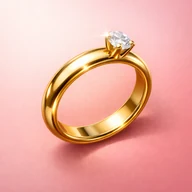
How tight should a ring be?
A well-fitted ring slides on with light resistance, sits at the base without spinning freely, and needs a small deliberate effort to come off over the knuckle. If it falls off when you shake your hand it is too big. If you cannot remove it in the evening it is too small.
“Comfortable” is not a measurement, which is why so many people struggle to judge whether a ring actually fits. You put it on, it feels fine, and you have no idea whether fine means correct or whether it will feel very different in August.
Here are three tests that turn a vague impression into something you can check.
How should a ring feel going on?
It should slide onto the finger with light, even resistance, and need a small deliberate push to get past the knuckle.
If it drops straight on with no resistance at all, it is too big. That is not a matter of taste: a ring that goes on freely will also come off freely, and it is how rings end up in coat pockets and swimming pools.
If you have to work at it, twisting and pushing repeatedly, it is too small. A ring should not require technique to put on.
The knuckle is where the resistance belongs. You should feel the band meet the joint, feel it pass, and then feel it settle at the base. If the resistance is at the base rather than the knuckle, the ring is genuinely too tight for the finger rather than just snug at the joint.
What does the spin test tell you?
Use rotation as one fit signal, not a diagnosis by itself. A well-fitted plain band can be turned deliberately but generally stays put during ordinary movement. Persistent rotation deserves a closer look, especially when a stone repeatedly moves toward the palm, but an oversized opening is not the only possible cause. A top-heavy setting, prominent knuckle, ring stack and temporary finger change can create the same symptom.
Test at more than one normal time of day and combine the result with the removal test. The dedicated ring-spinning guide owns the cause-by-cause diagnosis and compares temporary and jeweller-fitted remedies. This page keeps the broader job of deciding whether the overall fit is safe.
Why is the removal test the important one?
Because it is the test that fails safely and the one people skip.
Try to take the ring off. A correct fit needs a gentle twist and pull to clear the knuckle, and comes away in one movement without drama.
If it comes off instantly with no resistance, size down. If you have to work at it, or you find yourself reaching for soap, size up.
Fingers are at their largest at the end of the day. A ring that comes off easily at nine in the morning and refuses at nine at night is too small, and morning testing will never reveal it. If you only test once, test late.
What does a too-tight ring look like?
There are physical signs, and they are worth taking seriously rather than getting used to.
A visible indentation in the skin, or a red band that persists after you take the ring off, means the ring is compressing the finger rather than resting on it. Tingling or numbness in the fingertip is a circulation sign and should not be ignored at all. Skin bulging on either side of the band is the same problem from the outside.
The clearest functional test is the one above: any real difficulty removing the ring at the end of a normal day means it is too small, regardless of how it feels the rest of the time.
Persistently too-tight rings restrict circulation and can cause genuine harm if worn for years. This is not an aesthetic question, and if a ring you wear daily is leaving a mark, it is worth a trip to a jeweller rather than a shrug.
What does a too-loose ring look like?
A loose ring may slide toward the knuckle when the hand hangs down, pass the knuckle without any resistance or come off during a gentle shake. Those loss-risk signs matter more than occasional rotation. A stone can turn because the setting is top-heavy even when the opening is close, so do not size down from that symptom alone.
Loose fit is often correctable, but the remedy depends on the cause. A temporary guard can test whether reducing the opening helps; sizing beads can stabilise a ring that still needs knuckle clearance. Use the ring-spinning guide for the remedy comparison. If the ring can leave the finger during ordinary movement, stop wearing it until it is secured.
What if your knuckle is much wider than your finger?
Then no single size does both jobs well, and the tests above will give you contradictory answers. A ring that passes the knuckle comfortably will spin at the base, and a ring that sits properly at the base will not go on.
The fix is not a different size. It is a fitted solution: sizing beads for a modest gap, a spring insert or sizing bar for a larger one, or a hinged shank where the joint is fused or arthritic. All three are standard jeweller’s work rather than exotic requests.
The big knuckles guide covers how to measure both points and which fix suits which gap.
Does band width change what correct feels like?
Yes, and this trips people up when they buy a wider ring than they are used to.
A 2 mm band at a correct fit feels like almost nothing on the finger. A 7 mm band at exactly the same correct fit feels distinctly present, because there is four times as much metal in contact with your skin.
The mistake is to interpret that presence as tightness and size down. It is not tightness; it is what a correctly fitted wide band feels like. Apply the removal test rather than the sensation test, and if it comes off with a gentle twist at the end of the day, the size is right even if it feels more noticeable than your other rings.
Wide bands also need sizing up in the first place, for reasons covered in the wide band guide.
When should you deliberately choose a looser fit?
Several situations make the looser end of your range the sensible choice.
If your fingers swell noticeably in heat, after exercise or after salty food, size for the top of that range rather than the middle. If you work with your hands and they change through the day, the same applies. If you are pregnant or expect significant weight change, avoid committing to a snug fit you will outgrow within months.
And if the ring simply cannot be resized later, whether because it is tungsten, ceramic, or a full eternity band, take the looser option. A ring that is a quarter size loose can be tightened with beads for very little money. A too-small ring in a non-resizable material means buying it again.
What should you do if it does not fit?
Do not force it and do not leave it, particularly if it is on the tight side.
Work through what to do when a ring does not fit in order. The first thirty days are usually when a retailer’s own exchange or free resize policy still applies, and that is the cheapest remedy available by a wide margin. It also expires quickly, so it is worth checking the paperwork the week the ring arrives rather than the month after you first notice a problem.
Give a new ring a fortnight before you decide, though, unless it is obviously wrong. Fingers take a little while to get used to wearing something, and a ring that feels strange on day one often feels unremarkable by day ten. What should not change over a fortnight is the removal test: if it was hard to get off in the first week, it will be hard to get off in the fiftieth.