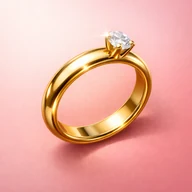
Wide band ring sizing: when to test a larger size
Wide bands can feel tighter, but there is no reliable half-size rule for every ring. For bands wider than 4 mm, GIA recommends wide finger gauges. Test the same width and interior profile in adjacent sizes, check joint clearance and removal, and use the maker’s chart for that specific design.
Two rings with identical inner diameters can fit completely differently. The variable is band width, and it is the most common reason a correctly measured ring still does not fit properly.
How much should you size up?
There is no universal increment. Use width to choose the right test method, not to calculate a finished size from a thin-band reading.
| Finished band | Safer test plan | What you are matching |
|---|---|---|
| Narrow band | Start with a calibrated finger or existing-ring measurement | The seller’s stated inside dimension |
| Band up to 4 mm | Compare the measured size with an exact-width sample | Width, edges and interior profile |
| Band wider than 4 mm | Use wide finger gauges and compare adjacent sizes | The full contact width and joint clearance |
| Several rings together | Test the complete stack in its intended order | Combined width, gaps and movement |
The Gemological Institute of America’s professional finger-sizing benchmark specifically calls for wide finger gauges for rings over 4 mm. That is a measurement method, not an instruction to add a fixed fraction of a size.
Why do wide bands fit tighter?
Several design details change what the wearer feels, and their combined effect differs by hand and by ring.
Skin contact. A wider interior rests against a longer section of the finger. Soft tissue can compress or bunch differently across that area, so a diameter that was comfortable in a narrow sample may not feel equivalent in the finished band.
Joint clearance. A narrow gauge clears the widest part of a joint quickly. A broad ring has to keep moving across it, which makes edge shape and interior contour important during both putting on and removing the ring.
Finger shape. Fingers are not perfect cylinders and change shape when bent. A broad band spans more of that changing geometry. These observations explain why a matched-width trial is useful; they do not predict a particular numerical adjustment.
Edges can concentrate pressure during movement across the joint. Rounded and square-edged bands with the same nominal diameter may therefore feel different, particularly with a prominent knuckle. Treat the edge profile as part of the sample you must match rather than translating it into a fraction of a size.
How does comfort fit change the adjustment?
It changes the comparison, but it does not create a second universal adjustment.
A comfort-fit band has a contoured interior, while a standard-fit band is flatter inside. Manufacturers use different curves, widths and size conventions, so two products carrying the same label need not feel identical. The contour can change edge pressure and how the band moves over the joint; only a matched sample or the maker’s sizing set tests the actual combination.
Ask which interior profile the seller’s chart and sample represent. If the listing offers a brand-specific sizing kit, use it and follow the instructions for that model. Do not combine a generic wide-band addition with a generic comfort-fit subtraction—the apparent precision is not supported by the finished ring.
How do you measure for a wide band?
Four steps, and the last one matters more here than anywhere else.
- Take a calibrated baseline measurement on the exact hand and finger, then repeat it under another ordinary condition rather than relying on one moment.
- Record the intended ring’s width, edge shape and interior profile from the listing or maker.
- Try adjacent sizes in a gauge or sample that matches those details, preferably using the maker’s own sizing set.
- Check that the candidate passes the joint without force, sits securely at the base and can be removed comfortably later in the day.
There is a shortcut worth knowing. If you already own a wide ring that fits well, measure that one instead and skip the arithmetic entirely, because its diameter already contains the adjustment. The method is in the existing-ring guide.
Does stacking rings count as a wide band?
Several rings worn together create some of the same contact and knuckle-clearance effects as one wide band, but they are not a single rigid object. Gaps, mixed profiles, ring order and whether the pieces will also be worn separately all affect the practical size choice. Treat combined width as a warning to test the complete set, not as permission to apply this page’s single-band table to every component.
The dedicated stacking rings size guide covers two-, three- and mixed-band combinations and how to preserve solo wear. For the specific engagement-ring and wedding-band pair, use the matching-band guide. This wide-band page continues to own one broad ring and its interior profile.
Reference table
| US / CA | UK / AU | EU / ISO | Japan | China | Russia | Diameter |
|---|---|---|---|---|---|---|
| 3 | F | 44.0 | 4 | 4 | 14 | 14.0 |
| 3.5 | G½ | 45.5 | 5 | 5 | 14.5 | 14.5 |
| 4 | H | 46.8 | 7 | 7 | 15 | 14.9 |
| 4.5 | I½ | 48.0 | 8 | 8 | 15.5 | 15.3 |
| 5 | J½ | 49.3 | 9 | 9 | 15.5 | 15.7 |
| 5.5 | K½ | 50.6 | 10 | 10 | 16 | 16.1 |
| 6 | L½ | 51.9 | 12 | 12 | 16.5 | 16.5 |
| 6.5 | M½ | 53.1 | 13 | 13 | 17 | 16.9 |
| 7 | N½ | 54.4 | 14 | 14 | 17.5 | 17.3 |
| 7.5 | O½ | 55.7 | 15 | 15 | 17.5 | 17.7 |
| 8 | P½ | 57.0 | 16 | 16 | 18 | 18.1 |
| 8.5 | Q½ | 58.3 | 17 | 17 | 18.5 | 18.6 |
| 9 | R½ | 59.5 | 18 | 18 | 19 | 18.9 |
| 9.5 | S½ | 60.8 | 19 | 19 | 19.5 | 19.4 |
| 10 | T½ | 62.1 | 20 | 20 | 20 | 19.8 |
| 10.5 | U½ | 63.4 | 22 | 22 | 20 | 20.2 |
| 11 | V½ | 64.6 | 23 | 23 | 20.5 | 20.6 |
| 11.5 | W½ | 65.9 | 24 | 24 | 21 | 21.0 |
| 12 | Y | 67.2 | 25 | 25 | 21.5 | 21.4 |
| 12.5 | Z | 68.5 | 26 | 26 | 22 | 21.8 |
| 13 | Z+1 | 69.7 | 27 | 27 | 22 | 22.2 |
What if a wide band arrives too tight?
Handle this carefully, because a wide band that is too small is harder to deal with than a thin one.
Do not force it on. A wide band that goes on with effort can be genuinely difficult to remove, and the effort itself swells the finger, which makes the next attempt worse. If it does not go on and come off comfortably, it is too small.
Check the exact ring’s options. Resize feasibility depends on material, construction, finish, stone placement and the amount of change—not merely the metal name. Ask the maker or a jeweller who has inspected the ring, and keep the return or exchange window open until the fit is settled.
Compare exchange with alteration. A new ring in an adjacent size may preserve the original construction and warranty better than modifying it. Get a written assessment before approving work, especially for patterned, plated, stone-set or multi-material bands.
More on what is possible, what it costs and what cannot be touched is in can you resize a ring.
Is a wide band the right choice for your hand?
Worth asking before you get as far as sizing it, because the answer changes what you should be shopping for.
Wide bands sit well on longer fingers, where there is room for the band without it visually shortening the hand. On short fingers a wide band tends to cut the finger into sections and make it look shorter still, which is why the same ring can look excellent on one person and wrong on another at exactly the correct size.
Prominent knuckles argue against very wide bands, or at least argue strongly for rounded edges and a comfort-fit interior, since a wide band with square edges over a large knuckle is the hardest combination there is.
None of that is a rule. It is worth trying a width on before committing to it, because band width is the single design choice that most changes how a ring feels through a working day, and it is much easier to judge on a hand than in a listing.