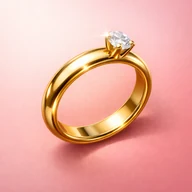
Comfort fit vs standard fit: which size should you order?
Comfort fit describes a contoured interior; standard fit is flatter inside. The label does not create a universal quarter- or half-size adjustment because makers use different curves, widths and sizing conventions. Measure a calibrated baseline, then use the brand’s sizing set or test adjacent samples matching the finished width and profile.
Two rings can share a size, a width and a metal and still fit completely differently. The variable is something you cannot see from the outside: the shape of the inside of the band.
What is the difference between comfort fit and standard fit?
It comes down to the interior surface.
A standard-fit band has a relatively flat interior. A comfort-fit band has a more contoured inside surface, with the edges curving away from the finger. Those are useful descriptions, but they are not universal engineering specifications: the depth of the curve and the maker’s measurement convention can differ.
The contour can change how pressure is distributed and how the edges feel while the ring crosses a joint. Width, thickness, edge shape and finger geometry still matter, so it is unsafe to infer a precise size from the label alone. Cost and weight also depend on the material and construction, not simply on whether the product is marketed as comfort fit.
How much should you size down for comfort fit?
Do not apply a universal reduction. Use the label to choose an appropriate sample, then let the fit test decide.
| Information available | Safer next step |
|---|---|
| Brand-specific sizing kit | Follow its instructions for the exact collection |
| Same-width comfort-fit sample | Compare the measured size and adjacent available sizes |
| Only a flat or narrow gauge | Treat it as a baseline, not the final comfort-fit order |
| Existing comfort-fit ring for the same finger | Compare width, profile and inside dimension with the new model |
| No profile information | Ask the seller before ordering and preserve the exchange window |
GIA’s professional sizing benchmark recommends matching wider rings with wide finger gauges. The same principle applies here: test the geometry being purchased rather than correcting a different gauge with arithmetic.
A wide-band addition and comfort-fit subtraction do not become accurate because they appear to cancel. Both are generic guesses about a finished object whose width, edges, curve and sizing convention may differ. Ask the maker for its tested sizing method and verify the exact profile in a sample whenever possible.
Which fit should you choose?
Comfort fit may be worth comparing if interior edges feel uncomfortable or if a broad band is difficult to move across a prominent joint. Standard fit may be easier to compare with an existing flat-interior ring or a stack whose other pieces use that profile. Those are reasons to try both, not guarantees about which one will fit better.
Interior engraving, weight, price and future alteration options depend on the actual design and maker. Neither profile is inherently superior. Judge the complete ring on the intended finger, including how it passes the joint, settles at the base, behaves when the hand bends and comes off after an ordinary period of wear.
What can comfort fit not do?
Two things worth being clear about, because both are common misconceptions.
It does not rescue a wrong size. Comfort fit changes how the ring travels over the knuckle, not the diameter of the hole at its narrowest point. If your size is wrong, a domed interior will not save it, and buying comfort fit as insurance against a bad measurement does not work.
It does not diagnose a spinning ring. Rotation may come from excess opening size, joint-to-base geometry, a top-heavy setting, stacking or temporary finger changes. Changing the interior profile without identifying the cause may leave the problem unchanged or create a new clearance issue. Use the spinning-ring guide before choosing an alteration.
How do you measure for comfort fit?
Home measurement establishes a calibrated baseline; it does not reveal how an unseen interior curve will feel. Record the inside diameter of a well-fitting ring or take repeated measurements on the intended finger, then obtain the proposed model’s width and interior details.
Use the brand’s sizing kit or compare adjacent samples matching those details. An existing comfort-fit ring is valuable evidence only when it fits the same finger and resembles the new ring in width and profile. Even then, compare its measured inside dimension with the seller’s chart rather than assuming the printed national size transfers perfectly between makers.
What about the other interior profiles?
Comfort fit and flat are the two you will see named most often, but there are others, and knowing the vocabulary saves confusion when a listing uses a term you do not recognise.
A half-round or D-shape often describes an outside curve with a flatter interior. A court profile usually describes curves inside and out. Knife-edge commonly refers to the outside ridge. Retail terminology can vary, so none of these names should be converted directly into a size adjustment.
The interior is especially relevant to fit, but the outside shape can affect stacking and how the ring balances. If a listing does not state or show the interior profile, ask for a cross-section, sizing-kit recommendation and exchange terms. Do not assume a profile merely because the outside photograph resembles another ring.
What is the practical rule?
If the listing says comfort fit, look for that maker’s model-specific sizing instructions. Give the seller your calibrated physical measurement, intended finger, band width and any base-to- joint difference, then ask which sample represents the finished ring.
The practical rule is to avoid offsetting formulas. Measure an existing same-profile ring when available, use an official sizing kit, or try adjacent matched samples. Confirm that the chosen sample passes the joint without force, remains secure at the wearing position and can be removed later under another ordinary condition. Keep the return window open until the finished ring has passed those checks.
For an online order, save the listing or email that defines the profile and sizing method used for that collection. Ask whether the supplied gauge matches the ring’s contact width, whether the printed size refers to a stated inside diameter, and whether an exchange changes the warranty. When the finished ring arrives, test it indoors under comfortable ordinary conditions without forcing it across the joint. Repeat the removal check later before discarding packaging or approving engraving. These details turn a vague profile label into a traceable fit decision and give the seller useful evidence if the sample and finished product behave differently.