Can ceramic rings be resized? How to get the fit right and arrange an exchange
A solid ceramic ring generally cannot be resized using ordinary metal-ring techniques. If it is too tight or too loose, ask the original seller about a size exchange or replacement. Before buying, test a sample matching the ring’s width and inside profile, confirm the sizing system, and read the rules for engraved, custom and international orders.
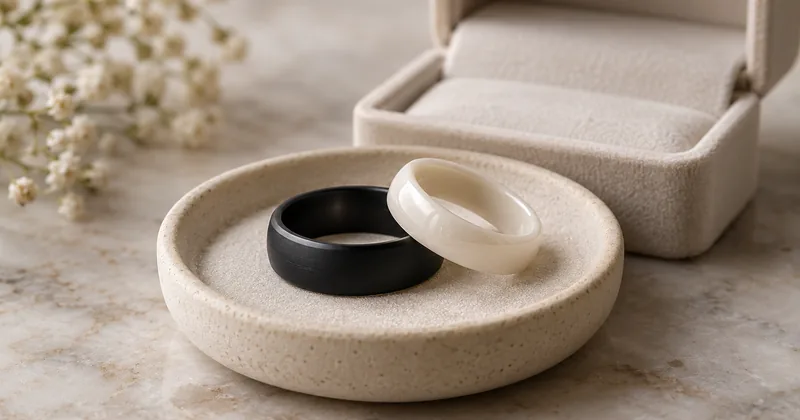
Can ceramic rings be resized? For a solid ceramic band, plan on a size exchange or a replacement rather than a traditional resize. This changes how you should buy one: the fitting and the seller’s exchange terms deserve attention before you approve engraving or remove return labels.
Ceramic rings can be appealing precisely because they hold a crisp shape and smooth finish. Those qualities do not make the material behave like gold. A jeweller cannot simply treat every hard band as a metal ring that can be cut, joined or gently reshaped.
This guide concerns ordinary ceramic jewellery. A ceramic-finish smart ring contains electronics and follows its manufacturer’s own sizing process. For that situation, use the smart-ring sizing guide, not a jewellery resizing calculation.
Why is an exchange usually the answer?
A ceramic band is a finished rigid component, not a ductile precious-metal shank. Attempts to stretch, squeeze or heat it are not a sensible home fix. Manly Bands explicitly says its ceramic Axle ring cannot be resized after manufacture; the same product page warns that sharp impacts can crack the material. The seller’s advice for your exact model takes priority over a general description of “ceramic.”
The practical distinction is between changing the existing object and supplying another object with the right opening. A shop may advertise “lifetime sizing” while fulfilling it through replacement. Ask which service is actually offered. It matters if the original band carries an engraving, a unique inlay, or sentimental value you want to preserve.
For other materials, the general ring-resizing guide explains why metal, construction and stone settings lead to different options. A repair that is routine for one ring can be unsuitable for another.
Does “ceramic ring” always describe the same construction?
No. Read the product specification rather than relying on colour. A black band might be ceramic, coated metal, tungsten or a mixed-material design. A ring can also have a ceramic component paired with another material. These distinctions affect the question you send to the seller, even if all the rings look similar in a thumbnail.
Ask for the base material, inside material, width, interior profile and any inlay or coating. If the listing is vague, send the product link or model code and request a written answer. “Can this exact ring be altered, or would you replace it?” is harder to misunderstand than “Is it resizable?”
Do not use a test involving scratching, impact or heat to identify the material yourself. You may damage the ring and make a return harder. For a second-hand or unlabelled ring, have a jeweller identify the construction before discussing any alteration.
Which measurements matter before buying?
Record the intended hand and finger first. Then note the finished ring’s width and whether its inside is flat or rounded. An old, slim ring gives useful background, but it is a poor substitute for testing the geometry of a much broader band.
GIA’s professional sizing guidance distinguishes wide bands and convex interiors from standard even-width rings. That is a reason to request a comparable sample, not a reason to add a universal half-size. The wide-band sizing guide and comfort-fit explanation help you describe what needs matching.
Use a phone estimate to prepare a shortlist, then test physical gauges from the seller if offered. Ask whether its sample corresponds to the model you want. If the seller sends only a thin plastic belt, find out how it expects you to account for the finished width rather than inventing a correction yourself.
A fitting example: the same number, a different purchase
Suppose you comfortably wear a narrow ring with an inside diameter of about 17.0 mm. You are considering an 8 mm-wide ceramic wedding band. The diameter estimate describes the old ring’s opening; it does not settle how the new band will feel against a larger area of the finger.
Make a short record before ordering: “Current ring: approximately 17.0 mm inside diameter, narrow band, left ring finger. Proposed ring: 8 mm ceramic, rounded interior.” Ask the seller which physical samples it recommends testing. Try the likely candidate and its adjacent sizes rather than committing to the first label that appears on a conversion chart.
This is an illustrative shopping example, not a recommendation for a particular size. The useful output is a product-specific fitting request. If the seller cannot supply samples, ask whether a local jeweller can test a comparable width and confirm which chart the seller uses. Keep that confirmation with the order.
How do you judge a sample without overthinking it?
Try the sample on the exact finger under ordinary conditions. It should reach the wearing position without force and come off with manageable resistance. Flex your fingers gently, relax the hand, and check whether the band pinches or moves so freely that it could be lost. Do not keep forcing a tight sample over the joint in the hope that the next attempt will feel better.
Repeat the assessment on another ordinary occasion. Write down what happened rather than just “good” or “bad”: easy at the base but difficult at the knuckle, comfortable until making a fist, or loose when the hand hangs down. A seller can do more with those observations than with an average of two size labels.
If the knuckle is substantially wider than the base, raise that issue before buying a non-resizable design. Our large-knuckle guide explains why choosing the smallest base measurement alone can leave you with a ring you cannot comfortably remove.
What should you ask about the exchange policy?
Read the actual policy for your destination and product, including the exceptions below the headline. Save a copy or screenshot with the date of purchase. A general banner saying “free exchanges” may have different rules for custom orders, engraving or international shipping.
| Question for the seller | Why the answer matters |
|---|---|
| When does the exchange window start? | Delivery, dispatch and order dates are different |
| Does engraving change eligibility? | Personalisation may affect fees or return options |
| Is this model stocked in the next size? | A replacement may require production time |
| Who pays shipping and any applicable import costs? | The practical cost can exceed the advertised exchange fee |
| Must tags, packaging and accessories be returned? | Missing items can complicate acceptance |
| Is a future size change covered? | A defect warranty is not automatically a lifetime size promise |
As one concrete example, the Manly Bands page linked above distinguishes engraved and international orders in its exchange information. Do not transfer that policy to another retailer. Ask your own seller what applies before you authorise work that may limit your options.
The ceramic ring arrived too loose. What now?
First keep it safe. If it can slip over the knuckle unexpectedly, put it in its box while you arrange the next step. Take photographs of the ring’s condition, check the ordered size against the packaging, and note whether the issue is at the base, the knuckle or both.
Contact the seller before fitting an adhesive pad or other temporary accessory. A removable adjuster may be acceptable for some jewellery, but it changes the wearing opening and can complicate the evaluation of an otherwise new ring. You need the seller’s answer for the finish, construction and return terms involved. The ring-adjuster guide explains the choices without treating them as a substitute for an exchange.
Ask for a fitting kit before choosing the replacement. “The current ring passes the knuckle with almost no resistance” is more useful than “send one size smaller.” An adjacent size might still be wrong if the original measurement used the wrong hand or system.
What if it feels too tight?
Stop the trial and remove the ring gently if it comes off easily. Do not try to “break in” a rigid ceramic band, sand its inside, or force it over a swollen joint. A tight ring needs a fit decision, not more determination. Contact the seller with the model, labelled size and a description of where it catches.
If a ring is stuck or a finger becomes painful, numb or changes colour, seek prompt professional help rather than attempting to crack the ring at home. The NHS finger-pain guidance identifies symptoms that need urgent assessment. Severe, sudden or unexplained swelling also needs medical assessment; the NHS hand-swelling guidance sets out when to seek help. This article is about jewellery selection, not treatment of swelling or instructions for emergency ring removal.
For a ring that is simply the wrong fit and removable, preserve its new condition and request an exchange. Do not let a return deadline pass while waiting for a hard material to become flexible.
How do you avoid repeating the problem on the replacement?
Separate the possible causes. Was the wrong size shipped? Did the order use the wrong regional system? Did a narrow reference ring fail to predict a wider band? Did you measure another finger? Each problem points to a different correction. Going down one label by default addresses none of those questions reliably.
Use the ring-size converter only after naming the original system. Preserve the millimetres as well as the label. Send your seller the old result, the proposed size and the observations from its fitting sample. Ask it to confirm the final choice in writing before posting the original ring back.
If the replacement is personalised, request confirmation that the message, typeface and placement will be reproduced. A size exchange does not necessarily mean the same physical ring is returned to you. That distinction is especially important for a wedding band worn at a ceremony.
What happens if your size changes years later?
Keep the receipt, exact model reference and original fitting notes somewhere you can find them. If the ring stops fitting, contact the seller with that information. Ask about replacement availability, any current sizing programme, and whether the design has changed. Do not assume a manufacturing warranty covers normal changes in fit or that a discontinued model can be remade.
You can preserve an original sentimental band while buying a different ring for daily wear. You can also discuss another suitable finger with a jeweller, provided the fit is genuinely secure. Neither option requires pretending the original ceramic can be resized. The right choice depends on how you want to use the ring and what the seller can actually supply.
The online ring-buying checklist is a useful final check before paying: confirm the construction, test the closest sample, agree on the size system, and understand the fallback if the finished ring does not fit.