Ring size adjusters: which type to choose and when to resize instead
A ring size adjuster takes up space inside a loose ring without necessarily changing the band’s original dimensions. Choose an accessory compatible with the shank width, thickness and material, fit it according to its instructions, and test removal as well as comfort. If the ring is very loose, valuable, damaged or difficult over the knuckle, have a jeweller assess it instead.
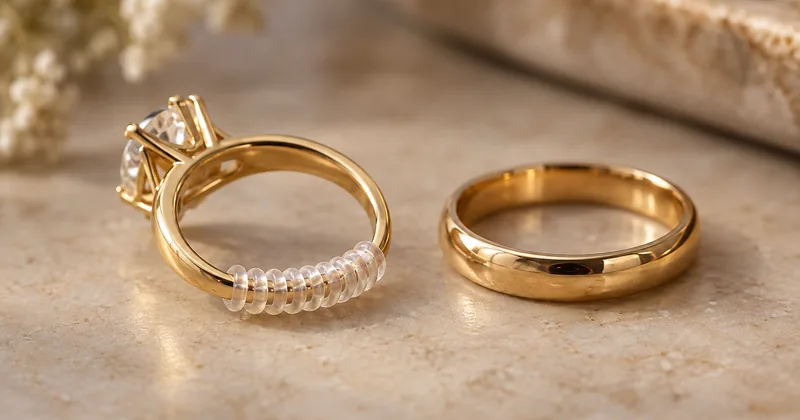
A ring size adjuster can be a useful temporary answer when a ring is a little loose and you are not ready to alter it. The right choice is not necessarily the thickest insert or the one described as “invisible.” It is the one that suits the ring’s construction, stays in place, feels comfortable and still lets you remove the ring safely.
This guide helps you compare adjuster types and inspect a fitted result. It does not rank products we have not tested or promise that an accessory reduces every ring by a fixed number of sizes. For a ring that mainly rotates, our ring-spinning article looks at balance and possible causes. Here the focus is on the insert itself: selection, fitting, checks and limits.
What does a ring adjuster change?
An insert occupies some of the space between the ring and your finger. The underlying band may retain its original opening while the available wearing space becomes smaller. That makes an adjusted ring different from a uniformly smaller ring, particularly when the insert sits only at the bottom of the shank.
Do not use an adjusted ring as the reference for a simple diameter-to-size calculation. A circular screen outline cannot fully describe an opening interrupted by a coil, pad or metal beads. Remove a removable accessory only as its instructions allow before measuring the original ring; have a jeweller assess a permanently fitted feature.
The distinction also explains why an advertised “one-size reduction” is not universal. Material thickness, placement, compression and finger shape affect the outcome. Treat a seller’s stated range as guidance for that product and verify the actual fit rather than converting it into a guaranteed jewellery size.
Start with the ring, not the accessory catalogue
Measure or identify the band’s width at the part where the adjuster will sit. Look at its thickness, shape and surface: flat, rounded, tapered, plated, engraved or stone-set. A piece designed to wrap around a thin plain shank may not fit a broad band or clear stones underneath a setting.
Check the ring’s condition under good light. If it is bent, cracked, has a loose stone or shows a damaged setting, stop and ask a jeweller about repair. An insert should not conceal a structural problem. It also should not require you to clamp hard against a stone setting to make it stay put.
For a new ring still eligible for exchange, ask the retailer before adding an accessory. That is especially important for adhesive products or delicate finishes. If the ring is simply the wrong size, a clean exchange may be more useful than finding an insert to accommodate an avoidable error.
How do the main types compare?
The names used by sellers vary, so inspect the product pictures and installation instructions. “Ring guard” can mean a size-reducing insert, a separate keeper band or a decorative surrounding ring. Those are not interchangeable products. Make sure the listing solves the problem you have.
| Type | How it takes up space | What to check before buying |
|---|---|---|
| Soft spiral or coil | Wraps around part of the lower shank | Suitable shank dimensions, secure ends, bulk between fingers |
| Clip-in plastic insert | Sits against the inside of the band | Compatible width and shape, retention, smooth contact edges |
| Adhesive pad or strip | Adds a layer to the inside surface | Finish compatibility, removal method and replacement instructions |
| Metal clip or guard | Grips the band and reduces wearing space | Professional fitting needs and risk to the finish |
| Jeweller-fitted beads or insert | Adds shaped contact points or a fitted component | Ring construction, knuckle clearance and future adjustment options |
An inexpensive removable option may help you evaluate whether occupying a small gap improves comfort. A valuable ring, difficult knuckle fit or persistent problem deserves an assessment before you move to metalwork or permanent changes.
Coils and clip-in inserts: fit the product you actually bought
Read the instructions before fitting a coil. Confirm which shank widths it supports and whether the maker permits trimming. Do not assume that a longer coil is always safer: added bulk may press against neighbouring fingers or make the ring unexpectedly difficult over the joint. If cutting is permitted, work with the ring off your hand and keep sharp tools away from the skin and stones.
A clip-in insert needs to seat securely in the intended position without being forced. Check that it does not rock, expose a sharp edge or push against a setting. If it repeatedly releases or slides into an uncomfortable position, the accessory may be the wrong shape for that shank. Do not compensate by bending the ring itself.
After either installation, inspect the contact surfaces and perform a short fit test somewhere safe. Follow the removal instructions too. An accessory that is easy to attach but difficult to remove without scratching the ring is not a good match for a delicate finish.
For a documented example, Lafonn’s coil instructions describe wrapping gradually, comparing the fit at intervals, then taking the ring off before trimming excess material and checking the ends. That sequence belongs to its product. Use the instructions supplied with yours rather than transferring a loop count between different coils.
Should you use adhesive pads or liquid “resizers”?
An adhesive pad deserves the same compatibility check as any other accessory. Ask the supplier whether it is intended for your finish, how long it should remain attached, how it is cleaned and what removes it. If those instructions are missing, choose a better-documented option rather than improvising with a household adhesive.
Do not apply craft glue, nail products or unverified curing compounds to jewellery as a sizing shortcut. You may create a residue, rough contact point or removal problem that is harder to solve than the original loose fit. A decorative finish, porous inlay or vintage surface deserves particular caution; ask a jeweller before applying anything.
If you buy a purpose-made adhesive accessory, follow that exact product’s instructions and stop using it if it loosens, irritates the skin or cannot be kept clean. A tidy-looking patch is not evidence of material compatibility. Neither this guide nor a product photograph can certify that a particular adhesive is safe for your ring or skin.
What are sizing beads and jeweller-fitted alternatives?
Sizing beads are small metal additions placed inside a suitable ring by a jeweller. They can address a gap at the finger base while leaving a different route over the knuckle. In his professional explanation of sizing beads, goldsmith Alan Revere describes their use for knuckle-to-base differences and top-heavy rings. Whether they suit your ring requires an individual assessment.
This is not a home soldering project. Ask the jeweller how the proposed change affects the construction, finish and stones, and how it could be modified later. Request a fitting check before collecting the ring. Two small contact points can feel quite different from a smooth, uniformly smaller opening.
For a substantial knuckle problem, discuss fitted or opening-shank solutions instead of repeatedly forcing an ordinary ring. The large-knuckle guide covers the questions to bring. Availability depends on the ring; there is no universal insert that makes all designs comfortable for every hand.
A worked example: choose by the shank, then verify on the finger
Imagine a plain metal ring with a 3 mm-wide lower shank that has become mildly loose. The ring is undamaged and still crosses the knuckle with some resistance, but it moves at the base. Before buying an adjuster, the owner checks that the product lists compatibility with that width and shank shape. They choose the smallest suitable configuration described in its instructions.
After fitting, they confirm that the ring still comes off with a gentle, controlled movement, that the insert stays seated, and that making a fist does not create a pressure point. If any check fails, the trial stops. There is no need to keep wearing a poor fit to justify the purchase.
This example is a decision process, not a claim that a particular product has been tested. A 3 mm width identifies one compatibility dimension; it does not specify how much the opening must shrink or establish which regional ring size will result.
Which checks matter during a wear trial?
Begin with a brief trial while awake in a safe setting. Check the wearing position, knuckle passage and removal before you continue with ordinary use. Move the fingers normally and notice contact with adjacent fingers. Reinspect the accessory after removing the ring; look for movement, damage, exposed edges or residue.
Remove the ring before activities where it could catch on equipment, following the relevant workplace or activity rules. An adjuster is not a safety device and does not make jewellery safe around machinery. Do not use a successful desk trial as permission to keep it on for every task.
Pain, tingling, numbness, colour change or a ring that will not come off safely are reasons to stop and seek appropriate help. Do not respond to pressure by forcing the ring repeatedly over the joint. NHS finger-pain guidance explains when symptoms need urgent help. The comfortable-fit checklist can help distinguish useful knuckle resistance from a fit that is simply too tight.
Cleaning, moisture and replacement
Use a cleaning method compatible with both the ring and the accessory. A method suitable for a plain metal band may be unsuitable for its stone, plating, adhesive or inlay. Follow the two sets of instructions; if they conflict, ask the seller or jeweller rather than choosing the stronger cleaner and hoping for the best.
Inspect the area beneath a removable insert when cleaning is permitted. Dry the ring and accessory as instructed before putting them back together. Stop using a piece that is torn, deformed, sticky, rough or no longer retained securely. Keep small loose components away from children and pets.
There is no reliable replacement schedule for every adjuster. Materials, wear and cleaning differ. Use the maker’s guidance and the condition of your own accessory. Replacing a worn insert with a fresh one also calls for another fit check; do not assume the old, compressed shape represents how the replacement will feel.
When is resizing or exchanging the better choice?
If a ring is substantially too large, an insert may create excessive bulk without producing a comfortable fit. If the size change appears persistent, ask a jeweller whether a proper resize is feasible. The answer depends on material, stones, previous repairs and construction, not only on how many sizes you want to change.
The resizing guide is the starting point for a suitable metal ring. For ceramic, see ceramic sizing and exchanges: a replacement is generally the practical route. An adjustable open ring is a different design again, covered in our adjustable-ring guide.
Smart rings need manufacturer-specific advice. An ordinary insert can interfere with a device’s fit, contact surfaces or charging. If that is your situation, read the Oura loose-fit article and contact the manufacturer before trying an accessory.
Keep a record of the original fit
Before an alteration, save the original ring measurement and describe the problem in plain words. Note the intended finger, shank width and whether looseness occurs at the base or over the knuckle. Keep any adjusted-fit notes separate so a future jeweller does not mistake the modified opening for the original circular size.
An app record can organise that information, but it cannot select an insert thickness or judge comfort. Use the existing-ring measurement guide for an unmodified, round ring and let a physical fitting settle the final decision.