Oura ring too loose after weight loss? Check the fit before replacing it
If an Oura ring becomes loose after weight loss, first see whether it fits securely and comfortably on another suitable finger or hand. Check the exact model’s fit guidance and contact Oura or your retailer if no finger works. Use the matching Oura sizing kit before selecting another size. Standard jewellery measurements and RingSizer cannot determine an Oura order size.
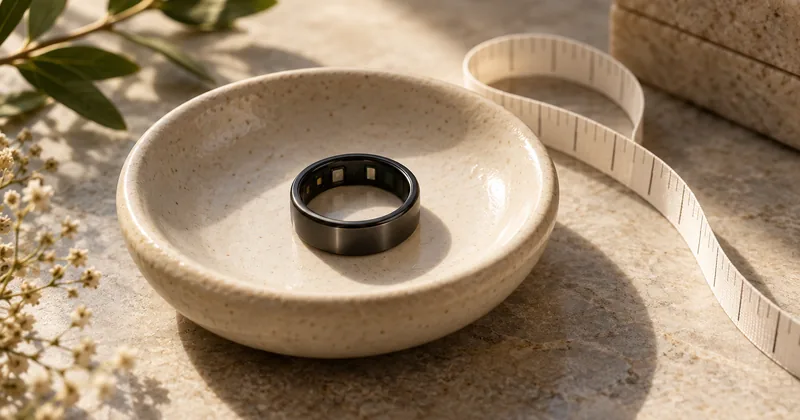
An Oura ring that has become loose after weight loss presents two problems: it may be easier to lose, and it may no longer maintain the contact needed for reliable readings. You do not have to decide immediately that the next smaller size is the answer. Check how the current ring fits, consider another finger, and gather the information needed for a sensible replacement decision.
Weight change is personal and is not always intentional. This article does not recommend changing your body to make a device fit. It addresses the device you already own. An unexpectedly loose ring also cannot diagnose how much weight you have lost or explain a health change.
RingSizer is independent of Oura and is not endorsed by it. Our jewellery tools can help you keep ordinary ring measurements organised, but they cannot choose an Oura size or test its sensors. For general background, see smart-ring sizing.
Is the ring actually too loose, or does it just move more?
Describe what changed before choosing a remedy. Does the ring rotate freely, lift away from the finger, pass the knuckle without resistance, or fall off during an ordinary motion? Does it feel secure indoors but loose when your hands are cold? These observations are more informative than the word “loose” on its own.
Check it somewhere safe, away from a sink, pavement or other place where a dropped ring could disappear. If it already slips off readily, put it away while you arrange help. Do not deliberately shake it off to test it. The goal is to observe the fit, not to prove that a loose object can fall.
Oura’s current fitting guidance calls for a snug, comfortable fit and suggests checking for a gap when you make a fist. Compare your ring with those instructions for its model. A device that pinches or cannot be removed comfortably is not an acceptable solution to a loose fit either.
Try another suitable finger before buying another ring
Oura says the ring can move to another finger or hand if finger size changes and the new fit is snug. Its sizing page recommends the index finger for accuracy, with the middle or ring finger also suitable. Test the candidate carefully rather than assuming the same finger on the opposite hand is identical.
Write down which hand and finger you tried and whether the ring stayed comfortable through normal use. Stop any trial that causes pain, numbness or problematic pressure. If it is clearly insecure on that finger, do not continue wearing it simply to collect more observations.
Our left-versus-right-hand article explains why a familiar size on one hand does not settle the other. For this decision, the manufacturer’s physical fitting instructions are more important than a jewellery chart. You are checking a sensor-bearing device, not merely moving a decorative band to a new position.
A simple fit log makes the next decision easier
Use a short note rather than repeatedly judging the fit from memory. You do not need to record body weight to describe a device problem. A useful log names the model, current marked size, finger, circumstances and observed behaviour. Record changes as observations, not diagnoses.
| Example entry | What it tells you |
|---|---|
| Monday, left index: slips over knuckle easily when dry | Current wearing position may no longer be secure |
| Tuesday, right middle: comfortable, remains in position | A candidate worth comparing with official fit guidance |
| Wednesday, same finger: pressure when making a fist | The alternative needs reassessment; do not force continued wear |
| Data gap during a walk; finger and battery state recorded | A specific event to discuss with support, not proof of a size fault |
These are illustrative entries, not outcomes from a product test. Replace them with what happens to your ring. A small amount of concrete information is more useful to support than a long account that omits which model or finger was involved.
Do missing readings prove the ring is too large?
No. A gap is a reason to troubleshoot, not a measurement of the correct size. Oura lists loose fit and dirty sensors among possible causes of heart-rate data gaps, alongside movement and other factors. Its data-gap troubleshooting page sets out checks for different types of readings. Follow the section that matches what you see.
Check fit and follow the manufacturer’s cleaning instructions before blaming every missing point on weight change. Note whether the problem began before or after the fit changed and whether it happens only during a particular activity. Send support a relevant screenshot if requested; review it first for information you do not need to share.
Do not tighten a ring painfully to chase an uninterrupted graph. Wearable data also cannot rule out a medical problem. If symptoms concern you, seek healthcare advice independently of what the ring records. The support team handles device behaviour; a clinician handles health concerns.
Can you add an adjuster to an Oura ring?
Ask Oura about your exact model before using an aftermarket insert. A conventional jewellery adjuster is designed to occupy space inside a band. A smart ring also needs appropriate skin contact and an unobstructed fit on its charging hardware. An accessory that looks tidy in a shop photograph is not evidence that it works with your device.
In your support question, name the model, current size and type of insert you are considering. Ask whether it is supported, where it may be placed, and whether it affects charging, sensor contact or the product’s coverage. If the manufacturer gives specific instructions, follow those rather than adapting advice for another generation.
Avoid glue, resin, sanding, heating or permanent alterations. Do not copy a spacer placement from a photograph of a different ring. Our ordinary ring-adjuster guide is about jewellery; it is deliberately not a set of Oura installation instructions.
Why you should not order “one jewellery size smaller”
Oura states that its sizes differ from standard US jewellery sizes and that sizing varies between models. Use the kit labelled for the model you plan to buy. Its fitting instructions call for wearing the appropriate sizer for at least 24 hours, including overnight, to assess normal changes in fit. Follow the manufacturer’s comfort and safety guidance throughout that trial.
Suppose your existing device is labelled size 9 and a jeweller records an ordinary ring size for your finger. Subtracting one from either number does not establish the next Oura size. The labels belong to different fitting systems, and the device geometry matters. Start the replacement decision with the appropriate physical samples.
Do not put your Oura ring on a phone’s circular sizer and treat the nearest jewellery label as a replacement recommendation. The measurement may describe an opening without reproducing the manufacturer’s fitting method. The ring-size converter is useful for ordinary jewellery conversions, not proprietary smart-ring orders.
What if you are still within the return window?
Check your receipt and contact the party that sold the ring. For a direct Oura purchase, its return and exchange FAQ currently describes a 30-day window from receipt for qualifying undamaged, functional products. Retailer purchases follow the retailer’s own process. Eligibility, model restrictions and what must be returned should be checked before sending anything.
Do not wait for a longer-term fit trend if doing so would quietly use up your decision window. Explain that the fit is insecure, ask how to obtain the correct sizing kit, and confirm the last date for initiating the requested action. A support message is not automatically an extension of the return period; ask for a clear answer.
Keep packaging and accessories together until the matter is resolved. Before shipping, follow the official instructions for the device and account. Keep the shipment receipt and tracking record. This avoids a second problem in which a fit issue becomes a missing-package dispute.
And if you have owned it for months?
Contact support without assuming that a change in finger size qualifies for a free replacement. A ring can function as designed and still no longer fit its owner. Explain that distinction in your request and ask what options are available for the specific model and purchase.
Prepare the model, marked size, order reference, approximate purchase date and a brief fit log. Mention whether you have already tried another appropriate finger. If readings are also missing, describe that separately rather than presenting it as proof of a defect. Support can assess the device symptoms and policy eligibility more effectively when the two questions are clear.
If buying another size becomes the practical option, repeat the official fitting process instead of predicting where your hands might be months later. You need a device that fits safely now. A future body-size assumption is not a dependable ordering method.
Keep a new fit routine gentle on the skin and the ring
A change of finger can change which objects the ring contacts during the day. Check ordinary comfort while typing and holding everyday items, and follow Oura’s care advice around activities that expose the ring to friction or impact. Do not make an insecure ring “safer” by crowding it against another valuable band.
Oura’s product-care guidance advises against wearing other rings directly alongside it because they may scratch each other. It also gives cleaning instructions for the ring and sensors. Use the guidance for your actual material and model; instructions for cleaning a ceramic exterior should not be transferred to every surface or finish.
Take persistent irritation seriously. A good data stream is not a reason to keep wearing something that hurts. Remove the ring when safe and seek appropriate advice if symptoms persist or are concerning. Sudden or unexplained swelling is a health question, not simply an invitation to change device size.
Where can RingSizer help, and where should it stay out of the decision?
If your ordinary jewellery also feels different, save fresh jewellery measurements separately from the Oura issue. Label the hand, finger and method so an old wedding-band size is not confused with a smart-ring size. The weight-change article covers that broader jewellery question without proposing a pounds-to-ring-size formula.
For the Oura itself, use the manufacturer’s fitting kit, care instructions and support team. The next useful step is to choose one: test another suitable finger if it fits safely, request a model-matched kit for a replacement, or ask support about unresolved fit and data problems.