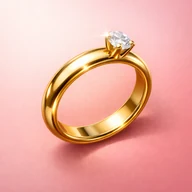
How to stop a ring from spinning on your finger
To stop a ring spinning, first determine whether it is too large, top-heavy, or loose only in cold conditions. A removable adjuster can test a small correction. A jeweller can then assess sizing beads, an insert, counterbalancing or resizing without making the ring too tight to pass the knuckle.
A spinning ring is not always the wrong ring size. A heavy stone can pull a correctly sized band around the finger, a large knuckle can force the opening to be wider than the finger base, and cold weather can temporarily reduce the support under the shank. The fix depends on which of those problems you actually have. Starting with “make it smaller” risks turning an irritating ring into one that cannot be removed comfortably.
Use this page to troubleshoot an existing ring. If you have not bought the ring yet and your measurement falls between two choices, use the between-sizes decision guide instead.
Why does a ring spin around your finger?
Rotation happens when the force pulling the decorative top sideways is greater than the grip and support provided by the band. The simplest cause is excess room at the base of the finger. A setting with a raised centre stone or broad top can magnify a very small amount of looseness because its weight sits farther from the centre of the finger.
Finger shape matters too. A pronounced knuckle may require a large opening to get the ring on, then leave space once the band reaches a narrower base. Some fingers taper toward the hand and give a band little ledge to rest against. Cold conditions, gradual weight change and ordinary daily variation can reduce the base temporarily without changing the jewellery.
The ring itself may also be out of round or have a worn, thin shank. That changes its contact with the finger and can shift the balance. Inspect the complete piece rather than assuming every rotation is a sizing error. The ring-size-by-hand-shape guide explains why the same labelled band behaves differently on tapered and knuckle-led fingers. Jewelers Mutual’s spinning-ring overview similarly separates overall looseness, finger shape, weather and an imbalanced setting.
How can you tell whether the ring is actually too big?
Test security, removal and timing. On comfortably warm hands, the ring should cross the knuckle with gentle resistance and sit at the base without threatening to slide off. If it passes back over the knuckle with almost no resistance, hangs away from the skin around the full shank, or can fall during an ordinary downward hand movement, excess size is a likely cause.
Now repeat later in the day and on another ordinary day. If the same ring is stable when warm but rotates only after cold exposure, a permanent resize to the cold reading may make it too tight in summer. The temperature and ring-size guide helps identify that pattern. If the fit changed gradually after a body change, measure rather than translating weight into ring sizes.
Compare with a plain sample ring of similar width if possible. When the plain band sits still but the decorative ring turns at the same opening, balance and setting height deserve more attention than diameter alone.
How can you tell whether the setting is top-heavy?
Place the ring upright on a level surface and look at how much metal and stone sit above the band. A tall basket, halo, large centre stone or wide decorative head moves the centre of mass away from the middle of the finger. Gravity then encourages the top to roll toward the side whenever the band has room to move. This can happen even when removal and knuckle resistance feel correct.
Observe when it rotates. A ring that consistently falls to the same side during gentle movement, yet does not slide toward the knuckle, behaves like a balance problem. A ring that roams freely in every direction and lifts away from the finger is more likely loose overall. Bent prongs, a twisted head or a distorted shank can also create one-sided behaviour, so stop wearing the ring and seek inspection if the rotation is new after an impact.
Do not add a tight guard merely to overpower a high setting. A jeweller needs to see whether the shank can support sizing beads, a counterbalance or another modification without compromising the design.
What can you try at home before changing the ring?
Use a purpose-made removable ring adjuster as a short, supervised fit test. Choose one that sits smoothly on the lower shank, has no sharp cut edge, and does not press into nearby stones or an engraving. Wear it for a limited normal period, then remove it and check both the skin and ring. If the rotation improves without discomfort or difficult knuckle passage, you have evidence that reducing space at the base may help.
Keep the adjuster clean and dry. Remove it if it traps moisture, cracks, changes colour, catches on clothing or makes the ring hard to take off. Do not build up layers of tape, thread, glue or clear nail product. Those improvised materials hold dirt and moisture, hide damage and can leave residue in a setting that needs professional cleaning.
An adjacent plain band can sometimes reduce movement in a stack, but it also increases the total width and may make the combination feel tighter. Test the complete arrangement using the stacking-ring sizing guide, not as an assumed universal fix.
When do sizing beads help a spinning ring?
Sizing beads are small metal domes attached inside the lower part of a suitable shank. They reduce side-to-side movement at the finger base while leaving more of the central opening available for the knuckle. That makes them especially relevant when a ring has to be large enough to cross a prominent joint but then rotates below it.
The GIA finger-sizing benchmark describes beads as a straightforward way to control turning when the finger joint is substantially larger than the ring location. A jeweller still needs to decide bead size, position, metal and attachment method for the actual ring. Delicate, hollow, patterned or stone-set shanks may require a different approach.
Beads are not invisible to the wearer. Some people like the extra control; others dislike the contact points. Ask whether the work can be reversed, how it affects engraving, and whether a temporary sample can simulate the sensation before authorising the change.
What other professional fixes can control rotation?
An internal spring-style insert or fitted liner can support a larger area than two beads. A hinged or adjustable shank can address a major difference between knuckle and base by opening for the joint and closing below it. A jeweller may also modify the shank, add a counterbalancing element, or recommend a better-shaped wedding band that supports an engagement-ring setting.
Each solution changes different things. An insert reduces usable space and may affect cleaning. A hinged mechanism adds moving parts and maintenance. A counterbalance adds material and weight. Shank work can affect hallmarks, engraving, stone security and future service. Ask to see an example and obtain the scope, reversibility and warranty effect in writing.
The best option is not the most elaborate one. It is the least invasive change that keeps the ring centred while preserving comfortable knuckle passage. The big-knuckle sizing guide provides a fuller comparison for fingers where ordinary sizing cannot satisfy both locations.
When should you resize the ring instead?
Resizing is reasonable when repeated warm-condition tests show that the whole opening is too large, not merely that the decorative top is heavy. Before cutting the shank, have a jeweller measure the ring, assess roundness, inspect every stone and compare the finger base with the knuckle. Ask how the proposed change affects setting geometry and whether it can be reversed.
Not every ring can be altered conventionally. Continuous stone settings, tension designs, unbroken patterns and several alternative materials can limit or prevent resizing. The can-you-resize-a-ring guide separates material limits from design limits. If the ring has recently become loose, also check whether the change is stable before making metalwork permanent.
Do not resize from a single cold-day test. Follow the best-time-to-measure guidance, record the behaviour for several days, and bring those observations to the appointment. A small temporary correction may be more appropriate when the fit changes seasonally.
Can a wedding band stop an engagement ring spinning?
Sometimes. A well-fitted band can occupy space beside an engagement ring and help keep the set aligned. A contoured or notched band may also nest around the setting and reduce independent movement. That result depends on the two profiles touching safely and on the combined width remaining comfortable.
Do not force mismatched rings together. Prongs, pavé edges and exposed girdles can rub neighbouring metal or stones, and a tight contour can make cleaning difficult. Take both rings to a jeweller so they can inspect contact points. If the pair is soldered together, ask how that affects future resizing, repair and the option to wear each ring separately.
Sizing the pair as a unit is different from sizing either ring alone. The existing guide to wedding-band versus engagement-ring size explains the basic two-ring fit. For three or more bands, total occupied width becomes an even larger part of the decision.
What should you do when spinning changes with the weather?
Use a reversible seasonal response when the same ring is secure in warmth and loose only during cold periods. A removable adjuster fitted correctly, a jeweller-approved temporary insert, or wearing the ring less during extreme conditions can manage the loose interval without making the warm fit smaller. Check security often because cold can also make a ring easier to lose outdoors.
If the ring becomes painfully tight in heat, the issue is no longer cosmetic rotation. Remove it while it still moves comfortably and reassess the overall size. A year-round ring must remain safe at the larger end of the finger’s ordinary range, even if that means using a modest support at the smaller end.
Keep a short fit log through the seasons before permanent work. Date, temperature context and a simple note such as “centred,” “rotated,” or “tight at removal” reveal a pattern far better than memory after several months.
When is a spinning ring a safety or repair problem?
Stop wearing the ring if rotation suddenly follows a knock, a stone becomes loose, a prong catches, the shank looks oval or cracked, or a temporary adjuster exposes a sharp edge. Spinning can be the first visible sign that the structure changed. Put the ring in a padded container and let a jeweller inspect it before further wear.
Treat finger symptoms separately. Pain, numbness, marked colour change or increasing swelling is not a fit experiment. If the ring does not come off with gentle movement, stop repeated forceful attempts and follow the safe escalation steps in what to do when a ring does not fit.
Also follow workplace rules. No jewellery material or adjuster makes a ring appropriate around every machine, electrical task, chemical or glove system. Remove it whenever the applicable safety procedure requires jewellery-free hands.
What is the best long-term way to stop spinning?
The best long-term fix matches the cause. Resize a genuinely oversized, resizable ring after the fit is stable. Consider sizing beads or a fitted insert when the knuckle requires a larger opening than the finger base. Ask about balance or shank changes when a high setting rotates despite sound overall fit. Use reversible help when the looseness is seasonal.
That diagnosis protects both comfort and jewellery. It also prevents a common cycle in which a ring is made smaller, becomes difficult to remove, and still leans because the top remains heavy. Bring the jeweller observations rather than a requested solution: when it spins, whether it slides, how it crosses the knuckle, and what changes with temperature. Those details lead to a much better repair decision than “please take half a size out.”
If you are considering a removable insert, compare ring size adjusters, coils and jeweller-fitted sizing beads, including the limits of each and when an insert is the wrong fix.
If it is a pinky signet that moves, measure the pinky itself and check both hands before relying on an insert or copying your ring-finger size.