Adjustable ring sizing guide: how should an open ring fit?
Size an adjustable ring by measuring the intended finger first, then choosing a model whose maker-stated range includes that result near the middle rather than at an extreme. Adjust only as the maker directs. The finished ring should cross the knuckle comfortably, sit without pinching, and resist slipping off during ordinary hand movement.
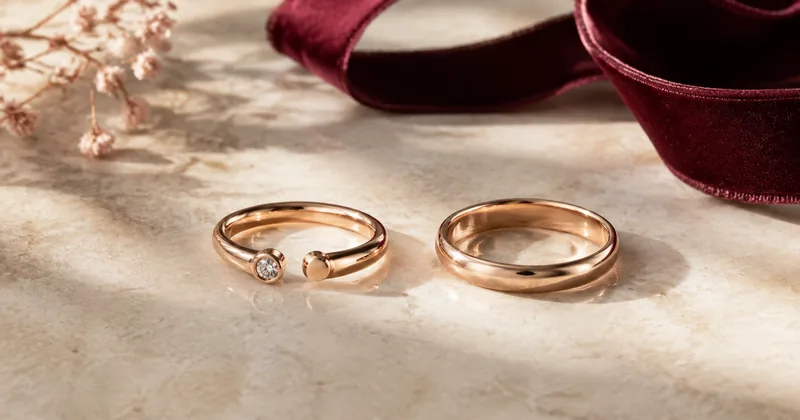
An adjustable ring still needs a size. The opening lets a suitable design make a limited change in fit, but it does not turn every ring into a universal one-size product. Start with the intended finger’s measurement, compare it with the product’s stated range, and check the ring at the base and knuckle. If the maker provides an adjustment method, follow it without repeated bending.
This adjustable ring sizing guide applies to ordinary fashion and fine-jewellery rings with an intentional open or moving construction. It does not apply to a cracked band, a ring that has been cut in an emergency, or a therapeutic ring splint. Those pieces need advice from the relevant professional rather than a home adjustment.
What does “adjustable ring size” actually mean?
An adjustable ring is designed to change its internal opening within a particular range. Some have an open gap in the shank, some use overlapping ends, and others include a mechanism. The advertised size may be a starting size, a minimum-to-maximum range or a broad label such as small, medium or large. Those descriptions are not equivalent, so the product page must say which one it uses.
The useful information is the maker’s range in a recognised size system or, better still, in inner circumference or diameter. If a listing gives only “one size,” ask for the smallest and largest intended fit and whether the ring is supplied pre-set. Do not infer the range by looking at the gap in a photograph. Scale, camera angle and the shape of the ring can make that opening misleading.
GIA’s professional benchmark for accurate ring sizing notes that rings with open space above the finger have less metal in contact with the hand and may fit differently. It also says the adjustment depends on the actual opening. That design-specific point is more reliable than a universal correction applied to every open band.
Do adjustable rings fit every finger?
No. A real adjustment range has limits, and reaching the limit can affect comfort, appearance and durability. A ring positioned at its smallest setting may bring decorative ends too close together or change how they sit on the finger. At its largest setting, the gap may widen, the ends may snag, and less of the shank may support the ring. A heavy top can then rotate even if the opening seems large enough.
Finger shape also matters. A pronounced knuckle may require more passage room than the band needs at the base. A tapered finger may give an open ring less support. The intended finger on the other hand can have a different measurement, so “it fits my right index finger” does not establish the size for a left ring finger. Use the ring-size-by-finger guide when choosing a location, then measure that exact hand and finger.
For a gift, an adjustable design reduces some uncertainty but does not erase it. Obtain an approximate measurement and choose a returnable model with a documented range. The ring-gifting guide compares less size-sensitive options when even an approximate ring measurement is unavailable.
How should you measure for an adjustable ring?
Measure where the ring will rest and confirm that the same opening can pass the widest joint. A proper finger gauge is preferable for a costly piece because it lets you experience an actual rigid opening. If measuring at home, take two or three careful readings on ordinary days and keep the unrounded millimetres. The finger measurement guide provides the base procedure and explains how to avoid compressing the skin.
Compare the result with the maker’s own chart, not a random marketplace graphic. Size labels vary by country, and a seller may round a converted value to the sizes it manufactures. If your measurement falls near one end of the stated adjustable range, ask whether a neighbouring base size would centre your result more comfortably. A medium ring adjusted almost closed may behave differently from a small ring opened slightly, even when their final diameter appears similar.
Band width must match the test. Repeat the reading and make sure the ring can pass the intended knuckle without force. For a wide adjustable band, test with a width-matched gauge or sample rather than a very narrow loop; the maker’s size range still needs to cover the result.
How should a correctly fitted adjustable ring feel?
Once set, the ring should pass the knuckle with deliberate, gentle resistance and settle at the base without pinching. It should not slide over the joint merely because the hand points downward or receives a light shake. A small amount of movement can be normal, especially with a raised or asymmetrical top, but the decoration should not rotate continuously during quiet activity.
Check the edges of the opening. They should not press into adjacent fingers, dig into the palm side or catch during normal dressing. Make a relaxed fist and then straighten the hand. The ends should not bite into the skin as the finger changes shape. Remove the ring using a gentle twist, not a hard pull. The ring-fit guide lists signs of a band that is too tight or too loose.
Repeat the check at another normal time of day before treating the setting as final. Do not test by sleeping, exercising or working with machinery in the ring. The NHS finger-pain guidance advises removing jewellery from a painful finger and seeking assessment for symptoms including tingling or numbness; after injury, it lists colour change or loss of feeling among urgent signs.
For swelling, the NHS hand and arm oedema guidance advises urgent assessment when it is unexplained, severe, painful, sudden, red or hot. If any of these changes occurs during a fit check, stop adjusting, remove the ring only if it comes off easily, and follow the medical guidance for your location. Do not turn the symptom into another size setting to test.
How should you adjust an open ring without damaging it?
Use the method supplied by the maker. Some rings are meant to be shaped once by a jeweller, while others allow occasional gentle adjustment by the wearer. Support both sides evenly and make the smallest change needed. Do not pull one decorative end as a lever, twist the two ends out of plane or use unprotected pliers. A stone setting, enamel panel, soldered joint or plated surface can be damaged even when the shank appears flexible.
One adjustable-ring maker, CHESI, states in its official size guide that its advice is general to the specific design and recommends avoiding repeated future adjustments after setting the fit. That instruction should not be copied blindly to another brand, but it illustrates the question every buyer should ask: how often and by what method is this exact ring intended to move?
Stop if the ring springs back, feels stiff, makes a sound, develops a visible line or will not stay round. Those are reasons for professional inspection, not more force. An open-looking ring may be decorative rather than designed for home adjustment.
How do width, profile and decoration change the size choice?
A broad band covers more skin and can feel snugger than a narrow ring with the same nominal inner diameter. A convex, comfort-fit interior may cross the knuckle differently from a flat interior. An open top reduces the amount of metal touching the finger, while a heavy gemstone or sculptural end shifts the ring’s balance. These effects can point in different directions, which is why a fixed “size down for adjustable rings” rule is unreliable.
Test the finished width and profile whenever possible. If the exact piece is unavailable, ask for a sample from the same collection and confirm whether it shares the same shank. Our wide-band sizing guide explains why a narrow gauge can understate the feel of a broad band. If the ring will join a stack, test all intended rings together; several comfortable slim bands can behave like one wider surface.
Decoration also changes the safe adjustment point. Ends set with stones must not collide, overlap unexpectedly or be pushed apart beyond the maker’s design. Preserve the intended orientation and gap shown in the product instructions rather than reshaping the ring solely to match a calculated diameter.
Can an adjustable ring solve a large-knuckle or changing-fit problem?
It may help within its intended range, but it is not automatically the right mechanism. For a larger knuckle and narrower base, the useful design must open enough to cross the joint and return to a secure base fit without difficult manipulation. A simple soft open band may not provide that repeatable action. A purpose-built hinged shank or another jeweller-fitted solution can be more appropriate for a large difference.
Measure both locations and show the jeweller the numbers. The condition-neutral big-knuckle ring guide compares joint clearance, base stability, sizing beads and opening mechanisms. If a medical condition affects swelling, pain or movement, use the separate arthritis ring-sizing guide and involve a qualified clinician for the health questions.
For ordinary warm-cold variation, an adjustable ring can offer useful flexibility if the range is small and predictable. It should not be used to clamp down on a cold finger or remain on through rapid swelling. A range large enough to make a closed ring unreliable deserves a professional fit, not a promise that the wearer can keep bending the ring each day.
What should you ask the seller before ordering?
Ask for the base size, the supported minimum and maximum, and the unit or national system behind those labels. Confirm the inner measurement at each end of the range and whether the stated range refers to the finger or ring. Request the band width, inside profile, materials and details of any plating, stones or joins. Then ask exactly how the adjustment is performed and how often the maker expects it to be changed.
The policy questions are equally important. Can the ring be returned after a first adjustment? Does bending it at home affect the warranty? Can the maker reset it, repair the shank or replace a failed mechanism? Is engraving permitted only after fit approval? Save the answers and the product page at purchase time. A marketplace label such as “adjustable” is not a substitute for these terms.
Use the online ring buying checklist to verify shipping, size exchange and custom-order exclusions. If the seller cannot state a supported range or adjustment method, choose a better documented product. Uncertainty should remain with a returnable sample, not an engraved final sale.
How do you care for an adjustable ring after sizing it?
Treat the chosen setting as the ring’s normal shape. Avoid opening and closing it as a habit or moving it between fingers of very different sizes unless the maker explicitly designed it for that use. Put it on and remove it over the knuckle rather than widening the band each time. Store it so the open ends are not crushed or caught by other jewellery.
Follow material-specific cleaning instructions. Water, solvents, ultrasonic cleaning and polishing that are safe for one metal or stone may be unsuitable for plating, glued components, enamel or porous gems. Inspect the gap, end alignment, stones and shank regularly. A change in symmetry, a crack-like line, loosened setting or inability to hold its size should be assessed by the maker or a jeweller familiar with the construction.
Do not attempt to restore a misshapen ring using a household cylinder or hammer. A ring mandrel is a measuring and workshop tool, not permission for an untrained repair. Professional help is especially important when the ring is sentimental, stone-set or covered by a warranty.
What is the final adjustable-ring sizing checklist?
Measure the intended finger and knuckle more than once. Identify whether the listing provides a starting size or a true supported range, and make sure your measurement is not forced to an extreme setting. Match the test band to the planned width and profile. Then check that the ring crosses the joint, stays secure at the base, does not press at the open ends and can be removed comfortably.
Before purchase, verify the construction, material, adjustment method, return conditions and repair route. Before changing the shape, read the maker’s instructions and stop at any resistance or distortion. After fitting, minimise repeated bending and inspect the ring over time.
The central rule is simple: adjustable means intentionally variable within documented limits, not limitless. A good adjustable ring gives a measured finger a little useful tolerance while keeping the maker’s intended shape and structural support. If you need a large range, frequent changes or a specialist opening for the knuckle, ask a jeweller for a design built for that purpose.