Ring Sizer by Jason Withers alternatives: what to compare
Ring Sizer: Measure & Try On is an alternative to consider when you want measurements, conversions and saved notes in one app. For a one-time task, a calibrated browser tool may be enough. Do not switch on an accuracy claim alone: compare the original units, current feature access and the workflow you need. This is our publisher-authored comparison, not an independent test.
Looking for an alternative does not necessarily mean your current ring sizer is bad. You might need a browser instead of an installed app, a clearer record for two people, or a way to keep the original millimetres while comparing a seller’s sizing table. Start with that missing job before downloading another utility with a similar name.
We publish Ring Sizer: Measure & Try On, so this comparison has a commercial interest. We checked public product information on 18 October 2026. We did not run a controlled head-to-head measurement test or establish that one app measures more accurately. The choices below reflect requirements you can check for yourself, not a score awarded by a review panel.
Identify the product before comparing it
The reviewed App Store listing for Ring Sizer by Jason Withers identifies the developer as Uniqo Lab. and lists a free download with in-app purchases. Its description includes diameter/circumference choices, metric/imperial units, international sizes, sharing and a jewellery catalogue with an enquiry route. Those are useful reasons to evaluate it, not features we should silently treat as absent.
Our separate iPhone listing is Ring Sizer: Measure & Try On, app ID 6759631149. The Jason Withers listing has app ID 795721582. Similar names and ring icons do not make them the same product. Use the exact listing when checking compatibility, subscriptions or support rather than relying on a search result’s shortened title.
This article compares the published iOS listing with our documented alternatives. It is not an exhaustive review of every release or platform offered by either developer. Store metadata can change, and the installed version’s current controls and purchase information take precedence over an old screenshot or a remembered price.
Decide what the alternative must do differently
Write a single requirement before making a shortlist. “I need to convert an existing diameter” is different from “I need to keep wedding-band records for both of us.” If the problem is uncertain physical fit, a different app may not be the missing tool at all; a suitable fitting sample can be more relevant than a new interface.
| Your actual requirement | A reasonable route | What to verify |
|---|---|---|
| Convert a measurement once | A transparent chart or browser converter | The input unit and the target seller’s table |
| Compare a fitting ring on a display | A physically calibrated screen workflow | Inner edge, placement and repeat readings |
| Keep several useful measurement notes | An app with records, or a structured note | Limits, retained fields and later access |
| Use no installed app | A browser tool | Current device calibration and what the browser retains |
| Confirm an expensive or non-resizable purchase | The maker’s fitting samples or a jeweller | Band width, profile, joint clearance and actual comfort |
These are requirements, not measurements of product quality. A tool that meets the first row may be the wrong choice for the fourth. Conversely, a record feature can be valuable even when you continue to use a different physical method to obtain the measurement.
Where Ring Sizer fits as an alternative
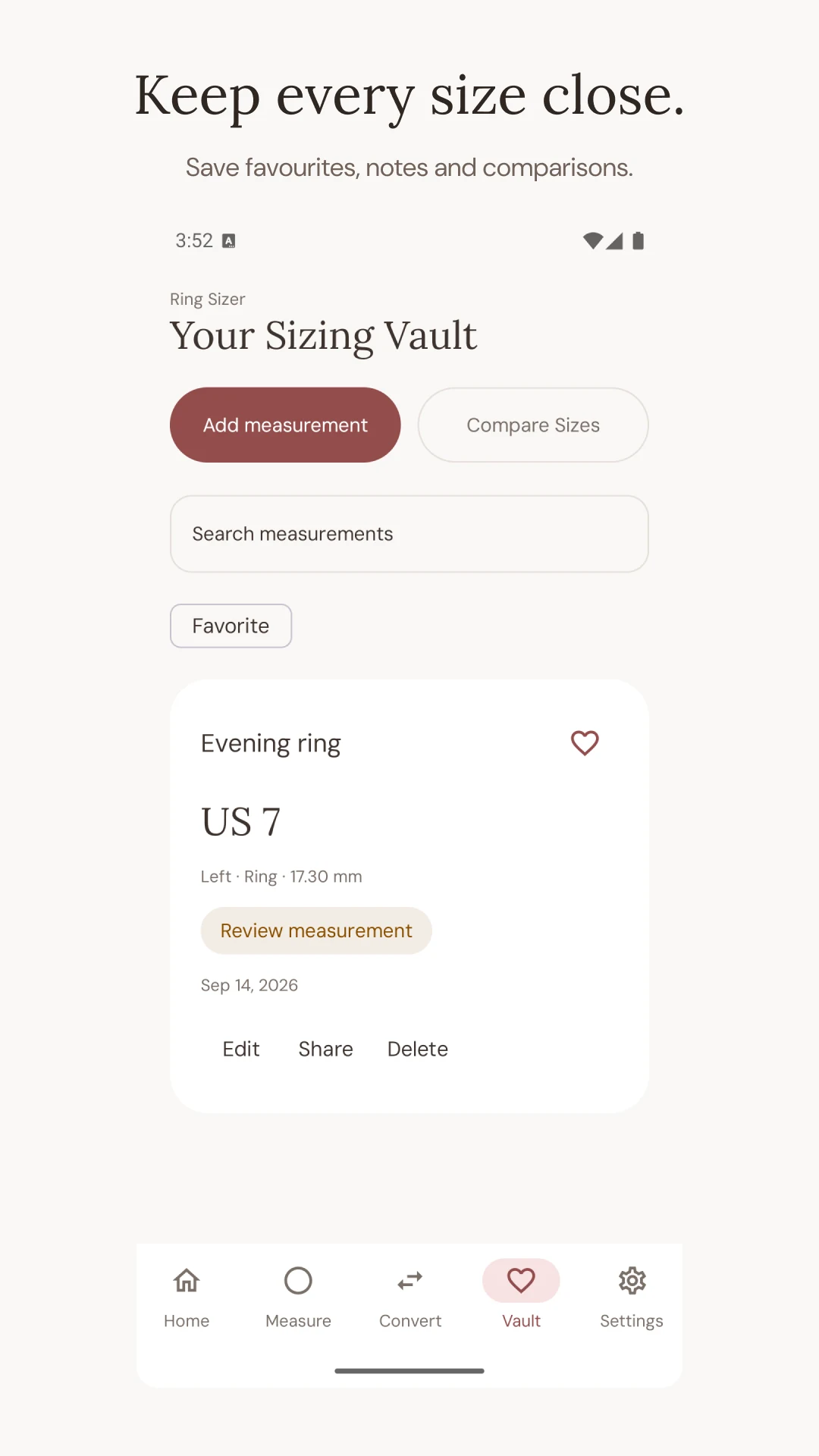
Our app is worth considering if your missing step is organizing the measurement after you make it. The official iPhone description includes a Sizing Vault with method, date and notes, alongside conversions and ring-style previews. The Android version describes saved notes, comparisons, sharing/export and optional upgrades. Treat each platform separately when checking the offer you intend to use.
A useful test is not whether the home screen looks friendlier. Create one clearly labelled record from a physically checked reading, close the app and see whether you can return later and explain that record without remembering the measuring session. If the answer is yes, the workflow has preserved information you can use with a seller.
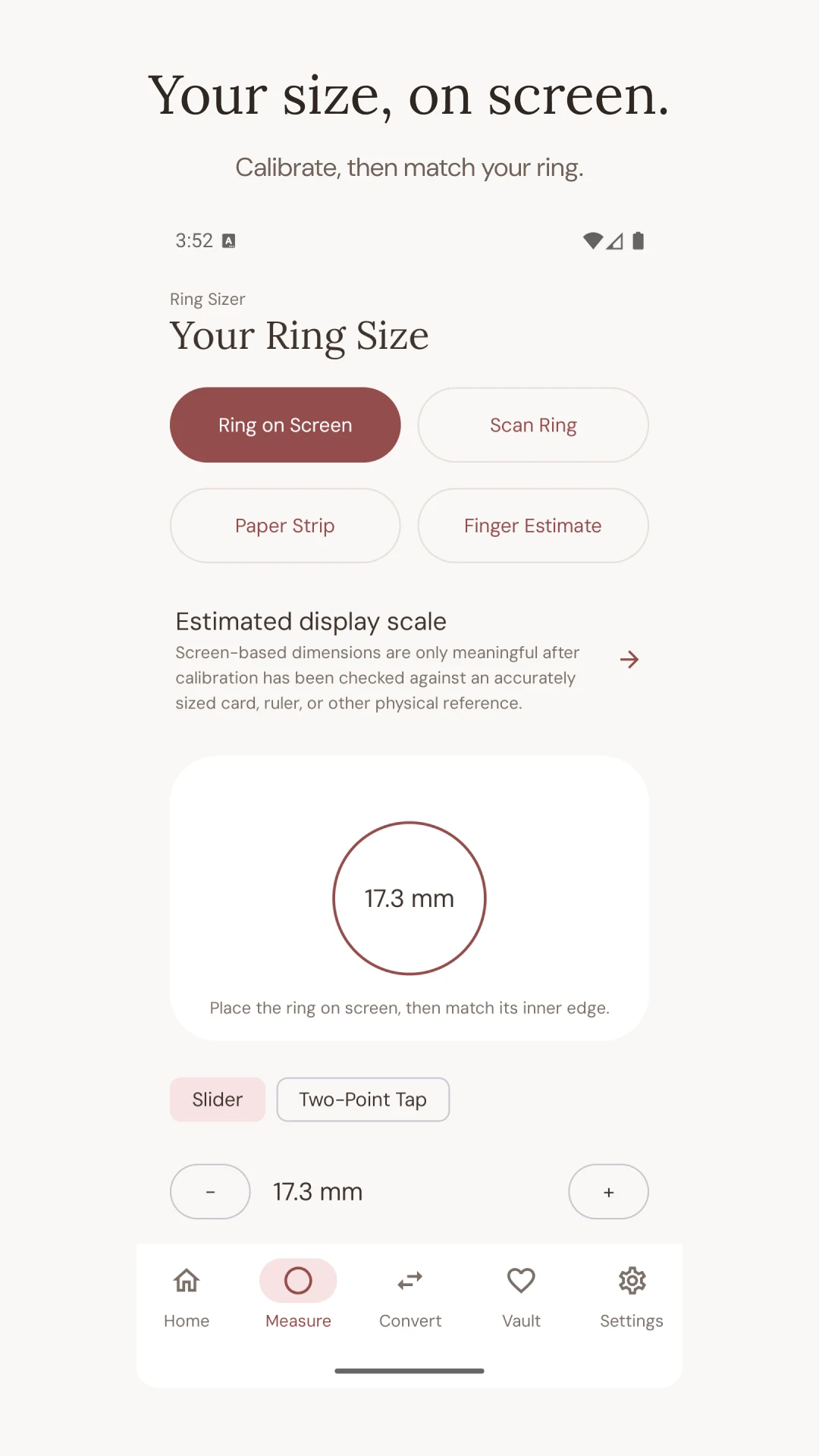
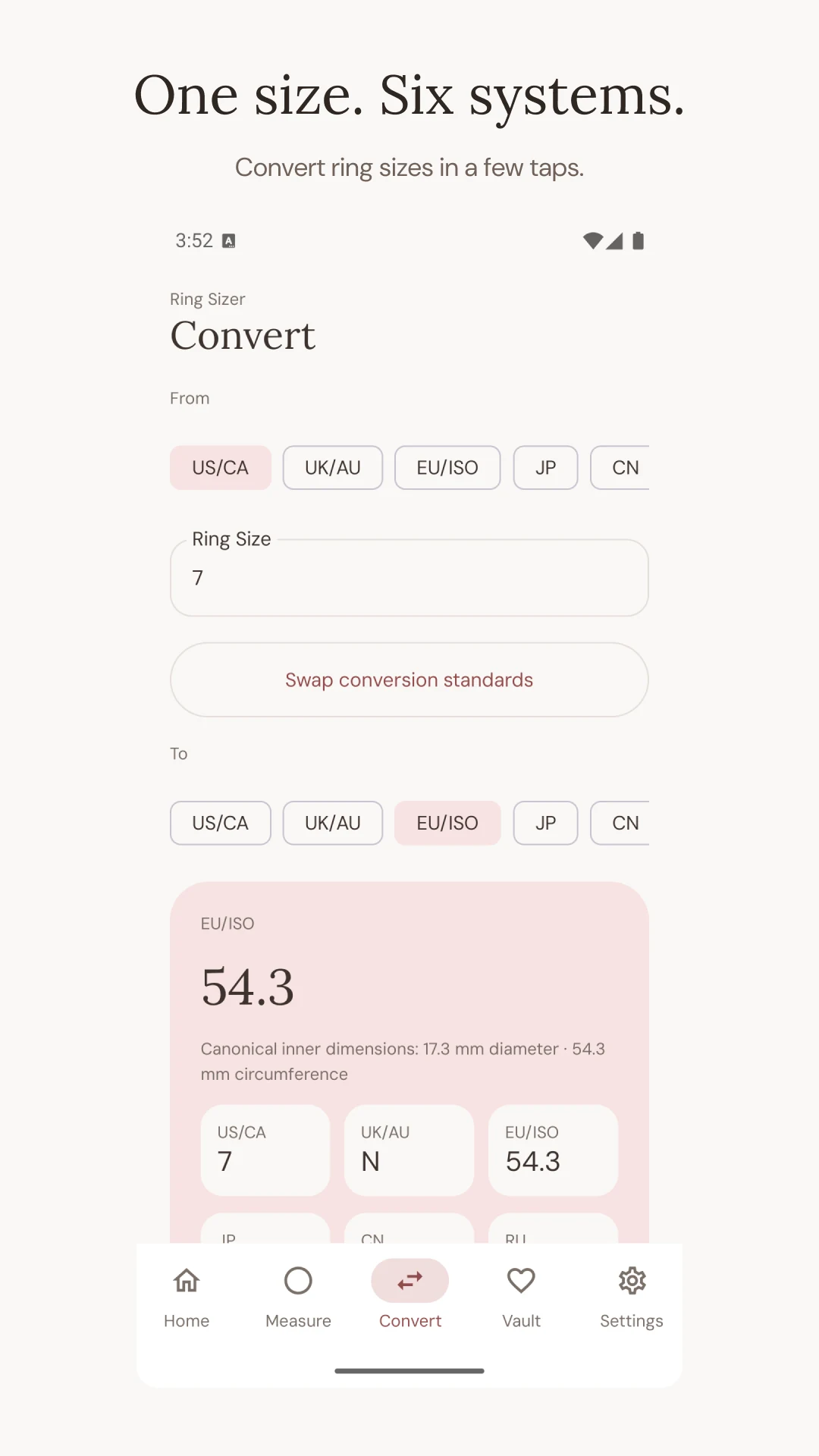
The examples below show real Android listing screens, not the Jason Withers interface and not an accuracy experiment. Read the original measurement and its method before acting on a rounded size code. You can follow the Android walkthrough or the iPhone workflow for platform-specific context.
Official Google Play screenshots, captured in English on Android. These images are not a calibrated measuring surface. App versions and reference charts may round size labels differently; keep your raw millimetre measurement and check the seller’s chart.
When keeping your current tool is the better answer
If your existing app gives you a reproducible, physically checked measurement and a record you can interpret, there may be no practical reason to switch. Familiarity matters when you are handling a small ring on a glass surface and trying to notice the inner edge rather than the metal. A new display is not automatically a better measurement.
Before replacing the app, check whether the problem is actually a chart convention. One tool can show a different letter or nominal size for the same raw dimension because it rounds differently or uses another reference table. Importing that rounded label into a second app and converting it again can make the disagreement larger without adding new information.
Also consider whether you want a sizing utility or a jewellery-browsing route. If the latter is part of what you already use, judge the overall workflow against that requirement rather than treating shopping content as a defect. Our app does not become the right choice merely because this article appears on its website.
Compare two tools using one clear physical reference
Use the same suitable round ring from the intended hand and finger. Keep the setup stable, check the physical scale in each tool and measure the empty opening through its centre. Lift and replace the ring for separate readings. Agreement after repeated placement tells you about repeatability; it does not independently establish accuracy.
For an illustrative opening of 17.3 mm, diameter times pi gives about 54.3 mm of circular circumference when rounded to one decimal. Our website’s nominal US 7 row lists 54.4 mm. The tiny difference comes from the distinction between direct geometric calculation and a reference table; neither number should be silently substituted for the other.
Record the original 17.3 mm inner diameter when comparing those results. If an app shows a nominal label, note which system and table it used. Do not claim that the table’s more familiar number is a new physical reading. The existing-ring measurement guide explains which openings are suitable and when a non-round ring needs a different assessment.
Move the information, not just the size label
Changing apps is a small data-handling task. Before deleting an old record, preserve the hand, finger, date, method, original value and unit. Add the reference ring’s width if you know it and a plain description of its fit. A screenshot can be a useful backup, but only if you can still identify what its number means.
For example, replace a bare “7” with an illustrative note such as “right ring finger; approximately 17.3 mm inside a narrow round ring; home screen estimate; joint passage still to be checked.” That note is intelligible in another app, a notes file or a message to a jeweller. A single rounded code loses most of that context.
Keep the original record until you have checked the replacement copy. Read it as if someone else had sent it to you: can you tell which part is a measured value, which part came from a chart and which part describes the wearer’s experience? If not, resolve the ambiguity while you still have the ring and the old record available. There is no benefit in losing a useful measurement history simply to make a phone’s app collection tidier before a purchase has been completed and its fit checked.
Do not assume a competitor’s export can be imported into our app, that an account syncs between products or that a sharing button creates a shared vault. We have not verified those transfer paths. Retain a readable copy you control, then check the specific import or export feature before relying on it for your only record.
Check current costs before making the switch
Both reviewed native iPhone listings disclose in-app purchases. That fact alone does not tell you which individual screen is free, whether an offer is a subscription or which local price will appear. This article deliberately does not infer a complete paywall map from the store’s installation price or present an old promotional offer as permanent access.
Check your particular requirement in the installed release before starting a trial or purchase. If saving many historical readings is essential, find the relevant allowance. If you only need one conversion, compare that cost with completing the task in the browser or using an ordinary note to retain a jeweller’s measurement.
Our free tools comparison separates those choices. A paid feature can be convenient, but buying it should answer a named need. It cannot turn an uncertain paper estimate or an unsuitable reference ring into a physically confirmed fit, and it should not be treated as insurance against ordering the wrong band.
A no-install alternative is also a valid choice
You may not want another native app at all. Our website offers a converter and calibrated on-screen sizing, and RingSize.app is an independent browser option. Evaluate either against the same requirements: the available input, a physically checked scale and a result whose units you can preserve.
Remember that a browser’s saved preferences and an app’s records are not interchangeable. Changing devices or clearing browser storage may change what is available later. Keep an independent note of the measurement if you will need it for a future purchase, rather than assuming the last number on screen will always remain there.
Finally, choose the seller’s fitting process over any app when the decision leaves little room for error. A custom or non-resizable ring needs a confident physical fit in the intended width and profile. The best alternative can be a different workflow, not a different download. That is a more useful decision than declaring a universal winner from two similar app names.