Ring sizer for couples: keep wedding-band sizes separate
A ring sizer app can help a couple keep two clear measurement records, but it should not infer one person’s size from the other’s or create a shared size. Save each wearer’s intended hand and finger, original millimetres, method and date. Then confirm each finished wedding band’s width, profile and joint passage with the jeweller. A shared notebook can serve the same recording job.
You both have a number, but the jeweller needs more than “mine is a 7 and theirs is a 9.” Which sizing system produced those numbers? Were they taken from the same hands you intend to use at the ceremony? Was one measured from a narrow engagement ring and the other with paper? These are practical questions to settle before the order becomes a pair of finished bands.
This workflow is published by Ring Sizer and describes a use for its saved measurement notes. It is not a claim that an app replaces a wedding-band fitting. The records below are invented examples for explaining units and handover, not measurements of customers or a study of couples. Product information was checked on 18 October 2026.
Agree which hands and fingers you are measuring
Make a separate entry for each wearer before choosing any size. Identify the intended hand and finger rather than assuming that every wedding band goes on the left ring finger or that an existing engagement-ring record describes the intended wearing position. If someone plans to change hands, treat the second hand as another fitting question.
Measure the actual intended finger independently. A partner’s size, height, shoe size or appearance is not a conversion formula. Even your own other hand is not a substitute. The left-versus-right fit guide explains why a familiar ring can behave differently without either original measurement necessarily being wrong.
Decide who keeps the notes and ask each person what they are comfortable sharing. One phone can hold two clearly labelled records if the installed app supports that workflow, but there is no need to create a permanent personal profile just to communicate a ring measurement. A readable joint planning document is also a valid option.
Use two records, not one couples’ size
For each person, record the physical value and how it was obtained. A measurement from a round ring’s inner opening is a diameter; a paper strip around a finger produces an estimated circumference. Keeping those labels makes the pair of records comparable without pretending that the methods have identical uncertainty or describe identical objects.
| Field | Illustrative wearer A record | Illustrative wearer B record |
|---|---|---|
| Wearing position | Left ring finger | Right ring finger |
| Reference | Narrow round ring that currently fits | Paper strip; no suitable reference ring |
| Original reading | About 17.0 mm inner diameter | About 59-60 mm finger circumference |
| Repeat check | Ring lifted and placed again | Fresh wrap and mark for each reading |
| Outstanding question | Fit of the proposed wider band | Joint passage and a rigid fitting sample |
| Ordering decision | Not confirmed | Not confirmed |
For A’s circular opening, 17.0 times pi is about 53.4 mm of circumference. That calculation does not measure A’s finger, and it does not justify averaging A’s result with B’s. The table deliberately stops before assigning order sizes. A jeweller can use the records to choose appropriate physical samples and discuss each finished design.
Keep the reference band separate from the planned band
An engagement ring can be a useful reference, but it is not automatically a fitting sample for a wedding band. A broader band or a different interior profile can feel different at the same nominal size. Record what the reference actually is, then test a sample close to the planned construction instead of applying a universal increase.
If someone will wear an engagement ring and wedding band together, explain that combination to the jeweller. The combined width and position matter to the fitting discussion. The wedding-band and engagement-ring comparison covers that question; it is different from organizing the couple’s two sets of notes.
Do not average the two people’s numbers to simplify an order, and do not copy a partner’s adjustment because you selected matching designs. Matching styles can require different physical sizes and individual comfort checks. Treat the order as two fittings with a shared design conversation, not a single calculation performed twice.
What to save in the app
Keep the hand, finger, date, method and original value in each note. Add a short description of the reference ring and any unresolved fit question. A useful note might say “left ring finger; narrow reference band; about 17.0 mm inside; home estimate; wider-band fitting still needed.” That makes sense even after the original session is forgotten.
The Android listing describes saved measurements and notes, with up to three records in the free version. Two initial records may suit a simple couple’s planning task, but a history across multiple dates is a different requirement. Review current limits rather than assuming that free storage is unlimited or identical on iPhone.
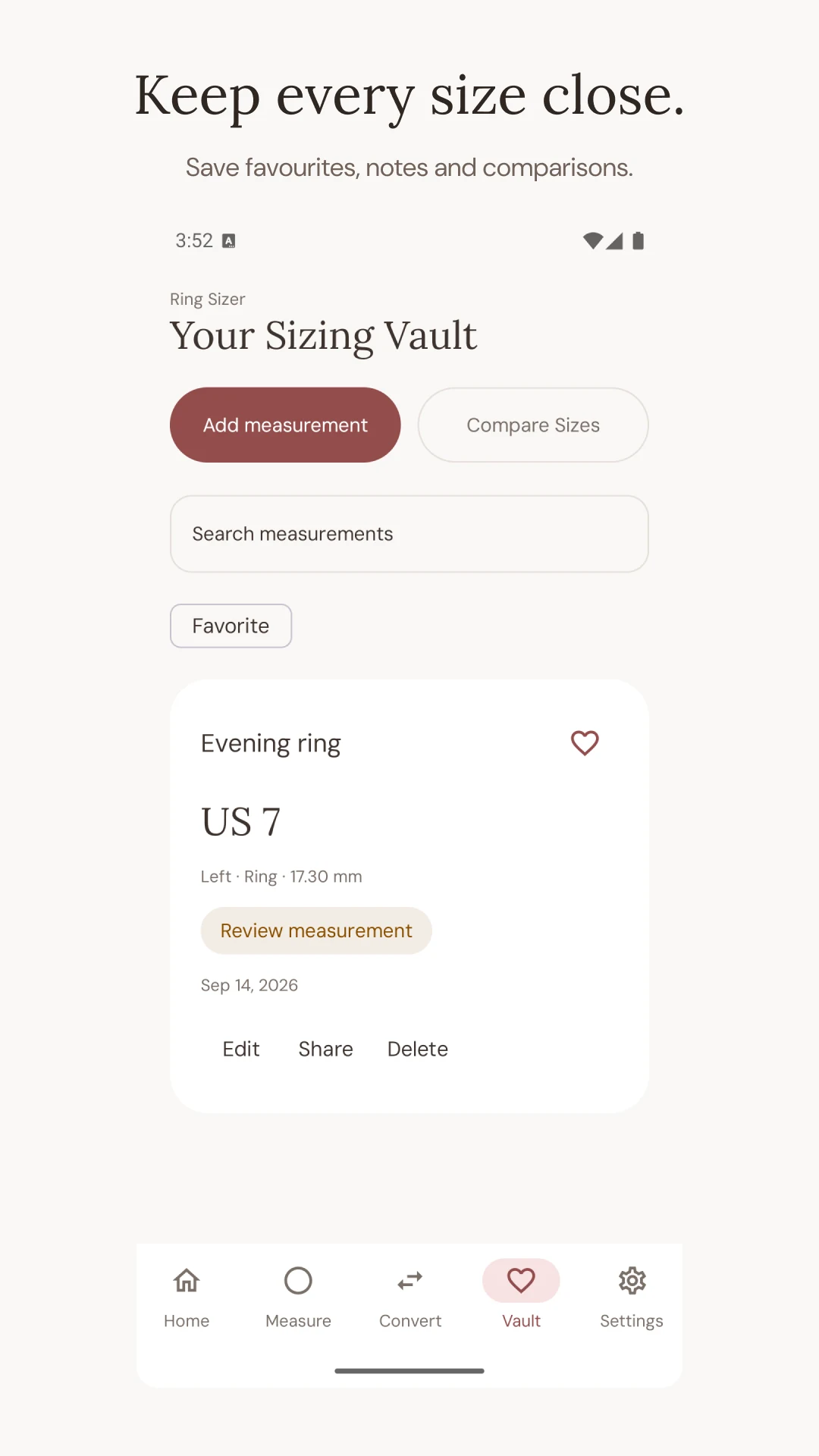
The actual Android saved-record screen below shows the record feature, not a shared account or a wedding-band order. Controls depend on the installed version. The iPhone workflow provides separate context for that platform. You can retain the same information in a notes app if that is easier for you both.
Official Google Play screenshots, captured in English on Android. These images are not a calibrated measuring surface. App versions and reference charts may round size labels differently; keep your raw millimetre measurement and check the seller’s chart.
A shared plan is not necessarily a shared vault
Saving two records on one device does not establish automatic access on a partner’s phone. Do not assume cloud synchronization, family storage, a shared subscription or cross-platform purchase access unless the particular feature and offer explicitly provide it. This article does not promise those capabilities as part of Ring Sizer.
Use a readable handover instead. Show the note at the appointment or manually share the relevant details with the other wearer and the seller. If you use a size card or export feature, check its contents before sending it. Include the original measurement and the intended finger, not just a badge containing an unexplained number.
Keep unrelated personal information out of that handover. A jeweller normally needs the sizing context, planned design and outstanding questions, not every record stored on a phone. Agree which records are current so a previous home estimate is not mistaken for a later physically confirmed order instruction.
Repeat for a reason, not to chase matching numbers
If a reading was taken under unusual conditions or you cannot reproduce the setup, record that fact and try again under ordinary conditions. Keep the range you actually observe. Repeated readings of one unmoved ring or one paper mark provide less information than fresh placements and fresh wraps that test the workflow itself.
Do not choose the most convenient reading because it matches the available stock or makes the two records look tidier. If the spread changes the order decision, arrange a physical fitting. There is no deadline-related formula that can remove that uncertainty. A measurement app is useful for preserving the question, even when it cannot settle it.
Our best-time guide discusses comparing conditions without predicting a fixed morning-to-evening change. Note the date and circumstances if they matter, but avoid turning a single temporary difference into a permanent resizing or ordering decision for either wearer.
Take a short handover to the jeweller
Bring each person’s record, the intended designs and any reference rings. Ask which sizing system the maker uses, whether fitting samples match the planned width and profile, and how each band should pass the joint and sit at its wearing position. Explain any plan to wear several rings together or alternate hands.
Before engraving or confirming custom work, ask what remains changeable and what the seller requires you to approve. Record the final agreed specification separately from the home estimate. Keeping both is useful: one explains how you began, and the other documents the decision made for the actual rings.
If ordering from an independent maker online, the custom-ring message example shows how to send a clear measurement brief without instructing the seller to manufacture from an uncertain app result. The practical benefit of a couples’ record is that neither person’s information gets lost while you make one shared purchase plan.