Buying a custom ring on Etsy? Send these size details
Before ordering a custom ring on Etsy, ask the seller which sizing system and fitting method they use. Send your intended hand and finger, the original measurement with its unit and method, and the planned band’s width and profile. Label a home reading as an estimate. Ask the maker to confirm a fitting process and the final order size rather than manufacturing directly from an app label.
The size dropdown is often the smallest part of a custom-ring listing, but it can carry the largest unresolved question. You may have a useful phone measurement and still not know what the maker means by that size, how their finished band will feel or whether the design can be changed after production begins.
This guide is published by Ring Sizer, not Etsy or an Etsy shop. It explains how to prepare a measurement brief, not how to obtain an automatic size guarantee, shop endorsement or refund entitlement. Etsy’s help pages and our product listings were checked on 18 October 2026; always read the actual listing and discuss the individual order with its seller.
Ask the seller before choosing a size
Use the listing’s seller-contact route to ask which sizing system applies to the product and whether the maker provides suitable fitting samples. Etsy’s contact-a-shop guidance describes messaging a seller before purchase. You do not need to guess the maker’s conventions from the country where the shop is based or from another shop’s size dropdown.
For custom work, ask what information the maker wants before you send an order instruction. Etsy’s custom-item guidance describes custom requests and discussing the specific item with the seller. A personalization box is not proof that a ring has been fitted or that the maker has accepted an unconfirmed measurement as a final manufacturing dimension.
Keep the initial question concrete: name the design, intended finger and measurement method, then ask how to confirm the fit for that product. Avoid sending only “What size am I?” with an ordinary hand photo. The picture may help discuss a style, but it does not establish a usable physical scale.
Prepare a measurement brief with units
A bare “size 7” is ambiguous. At minimum, include the system if you know it and the original value behind the conversion. A diameter from a fitting ring and a circumference estimated from paper are different inputs; do not let a tidy size code hide how the result was obtained.
| Detail | What to tell the seller | Why it matters |
|---|---|---|
| Wearing position | The actual hand and finger | Another finger or the opposite hand is not the order reference |
| Original value | Approximate diameter or circumference, with mm | Preserves the physical information before rounding |
| Method | Existing-ring opening, paper strip or professional fitting | Makes the source and limitations understandable |
| Reference band | Width/profile if known, plus how it currently fits | A different design may feel different |
| Repeated readings | A realistic range, not invented decimal precision | Shows whether the estimate changes the size decision |
| Planned product | Listing/design and requested width | Lets the maker discuss that actual construction |
Use the existing-ring guide if you have a round reference ring that fits the intended finger. Without one, use the finger-measurement workflow for a preliminary estimate and ask for physical confirmation. Neither method should silently become a final order instruction.
A message you can adapt
The following is an invented example, not a customer’s measurement and not a suggested size for your own hand. Replace every value with information you actually checked. If you do not know the reference width or the final profile, say so rather than filling the gap with a guess.
I am considering this ring for my right ring finger. A narrow round ring that fits there measures approximately 17.0 mm across the inside opening in a calibrated home screen comparison. I have kept the original diameter rather than treating a converted label as final. I would like your proposed 6 mm-wide band. Which sizing system do you use, and can you suggest a suitable physical fitting sample before we agree the order size? Please also explain which changes are possible before and after engraving or production.
For that illustrative opening, 17.0 times pi gives about 53.4 mm of circular circumference. That calculation describes the reference ring’s opening. It does not measure the finger, determine the custom ring’s final opening or establish how a 6 mm band will feel. Leave those questions in the discussion instead of presenting the calculation as the maker’s specification.
Save the record before converting it
Use an app note or an ordinary document to retain the original value, unit, hand, finger, date and method. Add the listing or design reference separately so the measurement is not confused with a decorative image. If the seller later gives you a confirmed order size, record that decision as a separate step, with the sizing system and agreed product details.
Ring Sizer’s saved notes are one way to keep this information together. The Android listing describes records with notes; the iPhone listing describes the Sizing Vault. Current controls and access depend on the platform and version, so check them before relying on one workflow for every person in an order.
Official Google Play screenshots, captured in English on Android. These images are not a calibrated measuring surface. App versions and reference charts may round size labels differently; keep your raw millimetre measurement and check the seller’s chart.
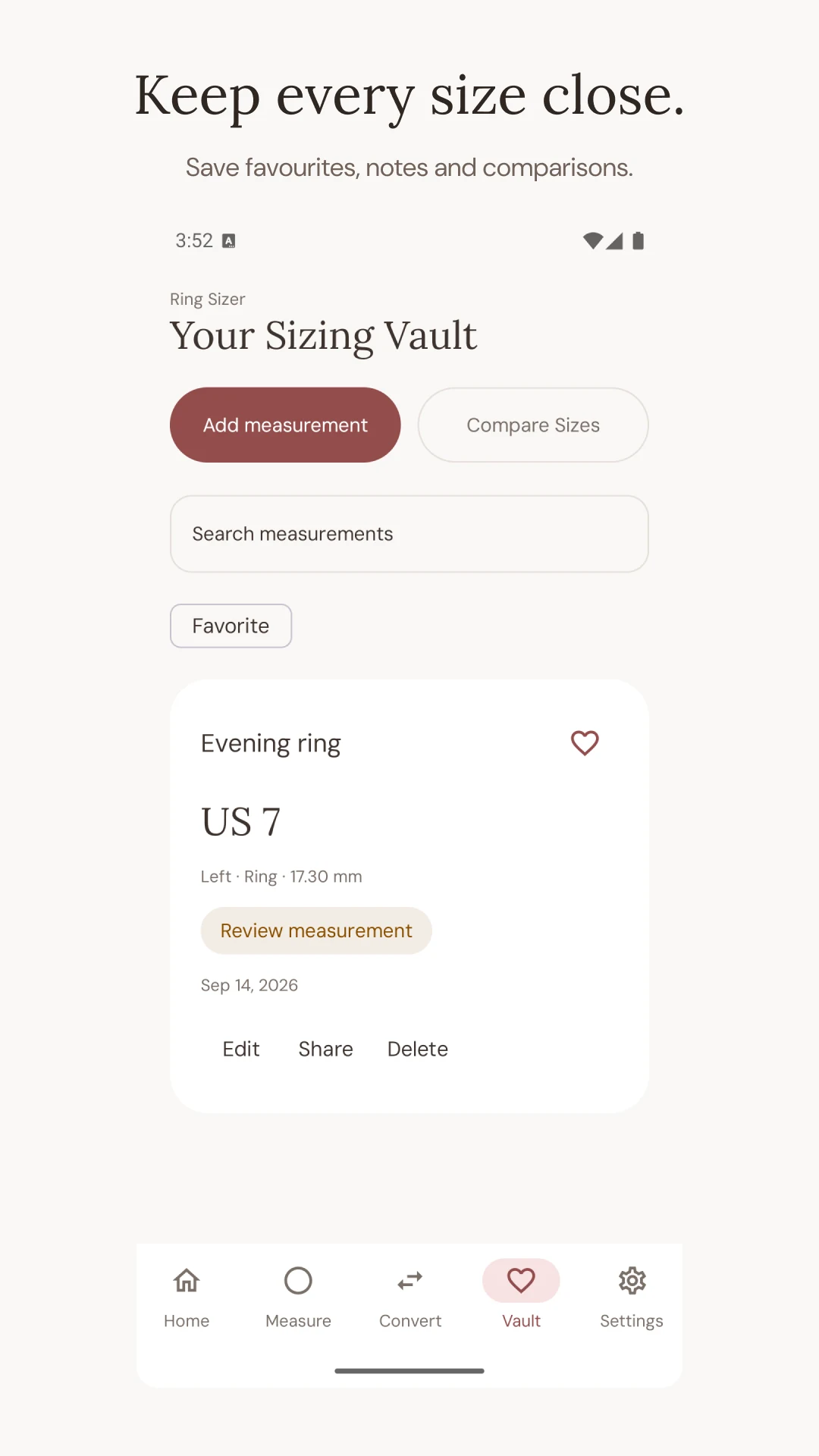
The screenshot is the actual Android saved-record feature, not an Etsy integration or an order confirmation. You still need to communicate the relevant details yourself and check what the seller has agreed. The app does not select a shop, obtain its approval or place a ring order on your behalf.
Use the maker’s conversion, not a chain of labels
If you measured a diameter, start with that diameter. If you measured a circumference, name it as such. You can use our converter to understand the rough relationship between systems, but ask the seller which table controls their finished ring. A numerical label by itself is not a universal manufacturing tolerance.
Avoid converting from an app’s US label to a UK letter on one site and then from that letter to a nominal EU number on another. Each intermediate step can round away part of the original measurement. Send the first physically observed value as well as any converted reference so the maker can see what information was actually collected.
If two tables disagree, that is a question for the seller rather than a reason to choose the smaller or larger label automatically. Ask whether the discrepancy matters to their design and how they recommend confirming it. A clear raw measurement makes that conversation more useful than a collection of conflicting screenshots.
Width, profile and changes need an explicit agreement
Tell the maker if the new ring is broader than the reference, has a different interior shape or will be worn with another band. There is no universal correction that can account for all of those designs. A suitable physical sample and the maker’s own process are more useful than adding a fixed fraction of a size on the strength of an unrelated guide.
Ask about changing the size before production, after production and after personalization. Those can be different questions for a particular construction. Do not assume a custom, engraved, stone-set or non-resizable design has the same options as a plain stock band. Our resizing guide explains why the design matters.
Read the specific listing and the seller’s stated process rather than treating this article as a promise about returns, remakes or refunds. We are not assessing a particular transaction or giving a universal interpretation of consumer rights. The useful task here is establishing which fit and dimensions you are agreeing before asking the maker to begin.
A style image is not a custom-ring specification
If you use a virtual preview to discuss preferences, identify it as an illustration. A generated view can help describe a general style, but it does not prove dimensions, metal colour, stone quality or the exact appearance of a finished item. Send the seller the real product reference and ask what will actually be made.
Ring Sizer’s preview feature uses selected gallery designs. It is not a claim that you can import any Etsy listing into the app or obtain a maker-approved rendering of that ring. Our sizing-versus-try-on comparison explains the distinction between style exploration, measurement and physical fitting.
Before paying, you should have a named design, an understood sizing system and a clear next step for any remaining fit uncertainty. If those are missing, a useful app record is a reason to ask a better question, not a reason to skip the conversation. For two wedding bands, keep both wearers’ information separate using the couples’ record workflow.