Ring enhancer sizing: will it fit your engagement ring?
A ring enhancer needs two checks: fit on your finger and compatibility with the engagement ring. Matching size labels do not establish that the centre opening, contour and setting clearance will work together. Have the actual pair assessed, then test the full arrangement before choosing a size or authorising alteration.
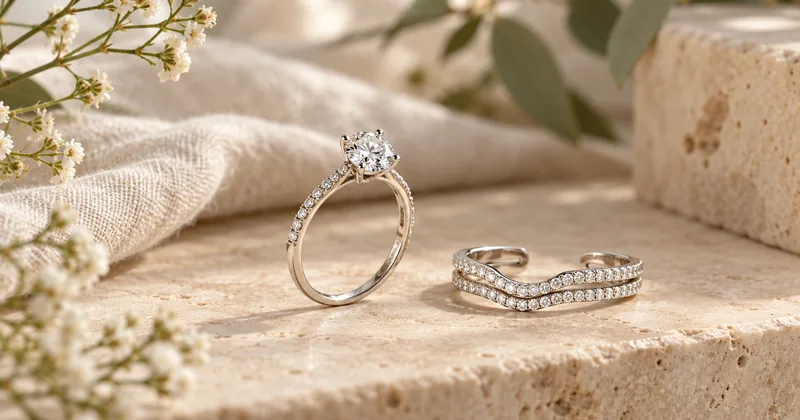
An enhancer can look like the missing piece around a solitaire and still fail to fit it. The finger opening is one dimension. The space that receives the engagement ring is another. A ring-size conversion only addresses part of the first question; it does not establish the shape, clearance or stability of the assembled pair.
This guide concerns jewellery jackets, wraps and enhancers. It does not concern the removable silicone coils sometimes called ring guards. If you want to reduce the usable opening of a loose ring, use the separate ring-adjuster comparison. Using the same name for those different products can lead you to buy something that solves a completely different problem.
Establish which kind of enhancer you mean
Blue Nile’s enhancer guide describes jackets, wraps and guards designed to surround another ring. It advises checking the widest part of the existing ring when evaluating compatibility and notes that resizing depends on the particular design. Those are useful starting points, not a guarantee that any two products from the same size row will fit together.
Save a product link or reference for both pieces. Include whether the enhancer is a single contoured band, a double-band jacket with a slot, or a design made specifically for the engagement ring. A front photograph may hide the underside or the place where the setting meets the shank.
If the seller describes it as a matching set, ask exactly which engagement-ring reference it matches. Similar gemstone shapes or the same metal colour do not establish that compatibility. If the design is custom, request a fitting or approval step that checks the actual pieces before the final work is completed.
Separate finger fit from the centre opening
Your ring size describes a candidate finger opening. It does not describe the width of the engagement-ring shank where it enters a jacket, the height of its basket or the curve around the centre setting. Those dimensions need their own assessment. Making the jacket’s finger opening larger does not necessarily create the right clearance around the engagement ring.
The practical questions are where the pieces contact, whether they settle in the intended position and whether either setting rubs the other. Do not force two pieces together to make the upper view look symmetrical. The jeweller should assess the assembled geometry and condition, including details that are hard to see in a product photo.
| Check | What a size label alone cannot establish |
|---|---|
| Finger opening | Comfort of the complete arrangement |
| Centre slot or contour | Clearance for the engagement-ring shank |
| Setting height | Whether the basket obstructs the enhancer |
| Contact surfaces | Whether stones, prongs or edges rub |
Why the same nominal size can feel different as a pair
Adding an enhancer changes the arrangement worn on the finger. It may occupy more width or hold the engagement ring in a different position. That is why the useful trial is the complete set, not two independent demonstrations that each ring can go on. The stacking guide explains this wider fitting issue.
GIA’s finger and ring sizing benchmark flags bridal sets with a combined width above roughly 4–5 mm for special consideration. It is a reason to use a representative fitting setup, not permission to add a universal half size to every enhancer order. Construction and the wearing position still matter.
Tell the fitter whether you need to wear the engagement ring alone as well as in the set. A decision that works only for the assembled arrangement may be inconvenient when you want to separate the pieces. Keep those two uses in the brief instead of expecting one label to describe every configuration equally well.
A worked inspection brief for an online order
Imagine that a buyer has a narrow solitaire and is considering a double-band jacket. Their old note gives a conventional size, but no product reference or setting dimensions. The next useful action is to identify both products and ask how compatibility will be verified. Copying the old size into the new order does not answer that question.
An example message is: “I would like to pair this enhancer reference with this engagement-ring reference. The engagement ring currently fits this hand and finger on its own. Can you check the centre opening and basket clearance, and arrange a fitting of the complete pair before personalisation?” Add measurements supplied by the maker without describing a photo estimate as a bench measurement.
This is a hypothetical communication example, not a tested combination. The important outcome is agreement on what the seller will inspect and which dimensions remain unknown. If the seller cannot assess the ring remotely, a local fitting or sending the actual ring through an agreed insured process may be more useful than more photographs.
Should you resize, open or solder the enhancer?
Treat alteration as a separate professional decision after inspection. An enhancer with stones around its band may have different options from a plain metal piece. Ask what the work would change about the opening, settings, finish and future service. Do not bend or spread a jacket at home to create space for an incompatible ring.
If soldering is suggested, ask whether the proposed benefit is alignment, reduced relative movement or another goal. It does not automatically fix the wrong contour or an unsuitable combined fit. Our soldered bridal-set fitting guide separates that permanent joining decision from ordinary stacking.
Get the scope and permission point in writing before work starts. Include the desired final arrangement and whether you want to preserve separate wear. Ask what happens if the approved pair still feels different on collection. A clear fitting and service plan is more useful than a broad promise that an enhancer is always adjustable or always resizable.
Record the two products and the assembled result
Keep the hand and finger, ordinary measurement, both product references and the arrangement that was actually tried. Useful notes include whether the engagement ring was worn alone, whether the full set cleared the joint and whether any contact point needed the jeweller’s attention. Do not replace the individual records with a single combined size number.
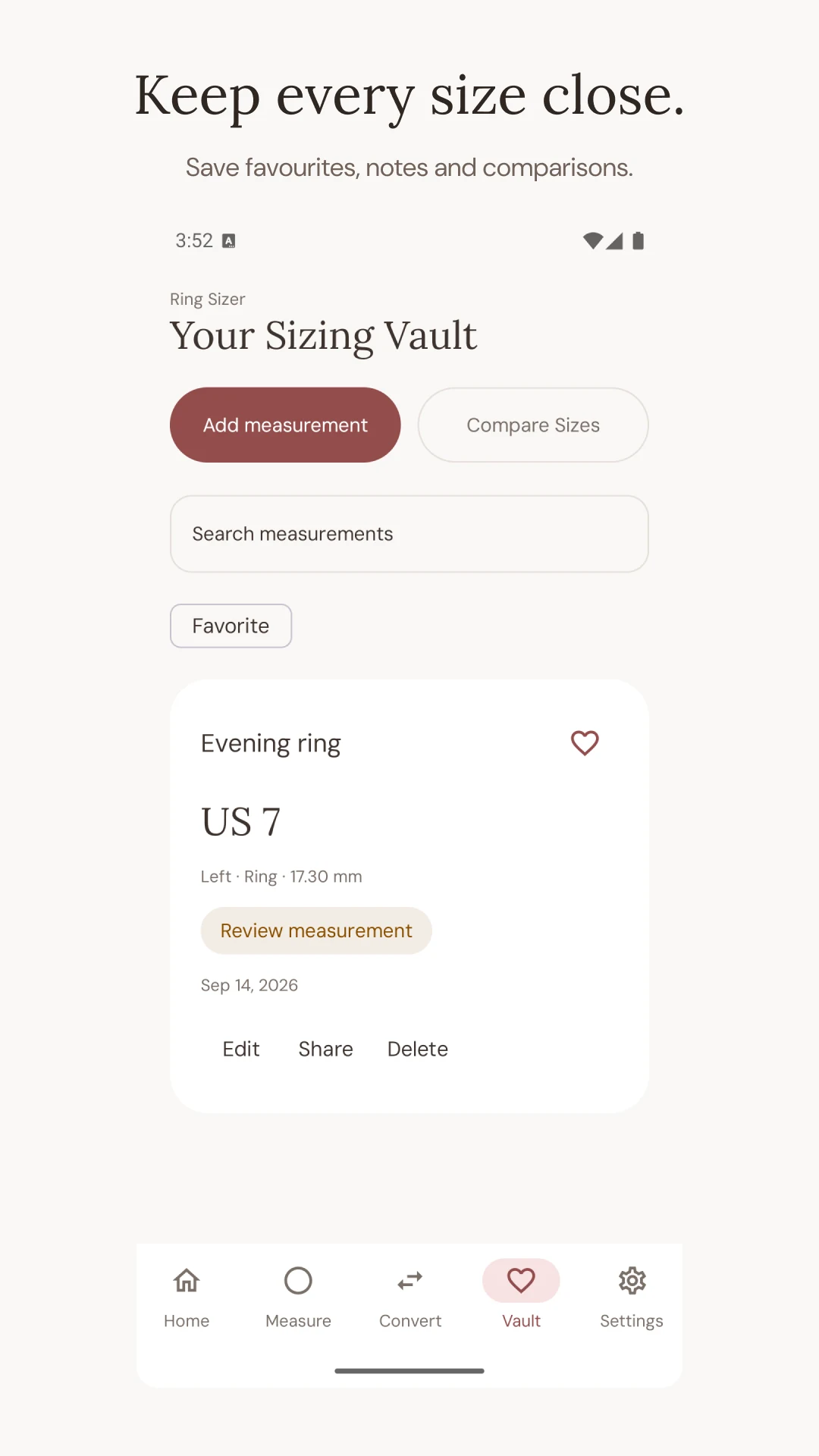
The Ring Sizer app’s saved notes can hold that context beside a measurement. It is not a verified enhancer-compatibility engine, and an AI try-on cannot demonstrate physical clearance. Its role here is to help retain the questions and the seller’s answers, not to inspect prongs or promise that a rendered jacket can be manufactured around your existing ring.
Official Google Play screenshots, captured in English on Android. These images are not a calibrated measuring surface. App versions and reference charts may round size labels differently; keep your raw millimetre measurement and check the seller’s chart.
Before buying, confirm the product-specific exchange and alteration terms and when any personalisation would occur. You need a ring arrangement that fits your finger and fits together. A matching pair of size labels is useful information, but those two physical checks are what make the intended combination worth ordering.