
Will soldering wedding rings together change their fit?
A joined bridal set can wear differently from two separate rings. Have the intended pair fitted together before soldering; do not automatically add a quarter or half size. Agree the alignment, comfortable joint passage and future servicing with the jeweller. Soldering controls how the rings move relative to each other; it is not a universal cure for incorrect sizing.
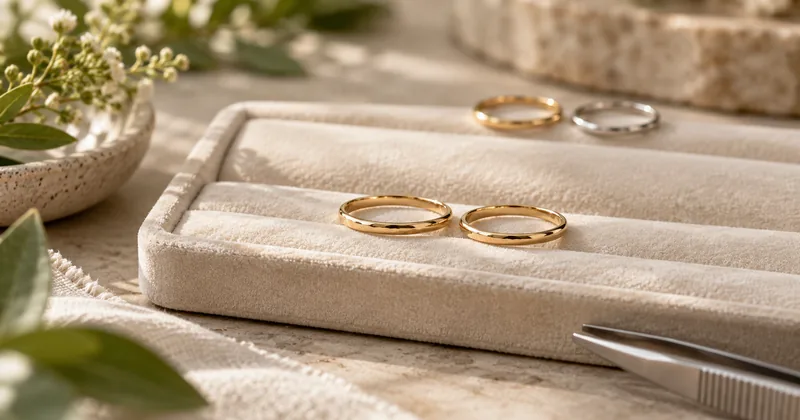
When two wedding rings keep turning away from each other, joining them can sound like a small tidying job. It is also a decision about the arrangement you will wear every day. The set needs to fit as a unit, come off comfortably and remain serviceable. A pleasing front view does not establish those things on its own.
This guide is a fitting brief to use with a professional jeweller. It does not give soldering instructions, recommend a filler alloy or promise that a particular ring can be altered. Keep questions about the work separate from the question of which size feels right. The jeweller needs both answers before a permanent join makes sense.
What problem are you trying to solve?
Describe the behaviour first. Are the two rings rotating relative to one another, is the whole stack rotating around your finger, or do the settings rub? Those are different problems. A join can change the relationship between the pieces without making an oversized overall opening smaller or creating clearance between incompatible settings.
Jewelers Mutual’s soldered-rings explanation describes joining separate rings and discusses benefits such as reduced relative movement, alongside the risks of alteration and later separation. It supports treating this as a considered service decision, rather than a universal sizing fix.
Write one sentence for the desired outcome: “I want these settings to stay aligned, while preserving comfortable removal.” Also state what you want to keep, such as the option to wear the engagement ring alone. If that second preference conflicts with joining the pieces, ask about alternatives before choosing a size for work you may not actually want.
Fit the complete arrangement before choosing the alteration
Bring both actual rings. Include any spacer or enhancer you plan to wear with them, and show their normal order. If the rings sit at different points on a tapered finger, testing them separately can hide the way the full arrangement occupies the wearing area.
Ask the jeweller to check comfortable passage over the joint, security at the base and ordinary movement with the complete set. If you already experience pressure with the loose pair, explain when and where it occurs. Do not assume the join will remove that pressure, or that making the opening smaller is the only way to improve alignment.
GIA’s sizing benchmark identifies wide bands and wider bridal sets as situations needing particular fitting attention. That is a reason to use representative physical evidence. It does not establish one fixed size increment for every soldered set. The stacking guide covers combined fit before you introduce the separate joining decision.
Does soldering always make rings tighter?
Do not reduce the answer to a universal fraction of a size. The wearing experience depends on the combined width, interior profiles, alignment and how the pieces can move. A pair that previously shifted independently may settle differently when its relative position is fixed. That does not tell you an exact new size without examining the intended arrangement.
Ask the workshop how it will assess the finished opening and how the fitting will be verified after the work. If a size change is proposed, request an explanation tied to your rings and trial, not simply to the fact that two pieces will be joined.
Keep a note of what was tried before work. “Both rings together, in this order, comfortable on this finger” is different from “engagement ring fits alone”. If your only previous record describes one band, arrange the missing complete-set check. The wedding-band versus engagement-ring article explains why a familiar single-ring label can leave that question open.
Agree the alignment and future service in advance
Show the exact front, side and underside arrangement you want the jeweller to assess. Ask where the rings would be joined, whether their settings have adequate clearance and how the proposed work would affect cleaning and inspection. Do not force one ring beneath another to eliminate a visual gap before that contact has been checked.
Discuss future resizing, repairs and possible separation. Ask which work would need the pieces to be separated, what that could involve and what can be preserved if your preferences change. A statement that a join can be undone is not a guarantee that separation will be invisible, risk-free or suitable for every design.
If a retailer warranty or manufacturer service matters to you, obtain its current requirements before using a different workshop. This article does not determine your contractual rights or promise coverage. Record who will do the work, what they will inspect and which changes require your approval before they start.
A before-work record that can be checked on collection
The following is an illustrative worksheet, not an account of a repair we performed. Fill it with the actual workshop’s measurements and your own observations. Leave unknown fields pending instead of inventing a nominal value to make the form look complete.
| Before work | What to retain |
|---|---|
| Rings | Product identities and condition notes |
| Wearing arrangement | Order, orientation and any additional band |
| Finger | Intended hand and finger |
| Fit | Joint passage, resting security, movement and removal |
| Proposal | Any size change and the jeweller’s reason |
| Appearance | Agreed alignment and features to preserve |
| Collection | The physical checks to repeat after work |
Photographs can help communicate alignment, while a written record preserves the scope of the discussion. They do not replace the jeweller’s condition assessment. Avoid posting a private inscription, serial number or personal paperwork publicly merely to obtain general advice about a fitting problem.
Use app notes for the history, not the soldering decision
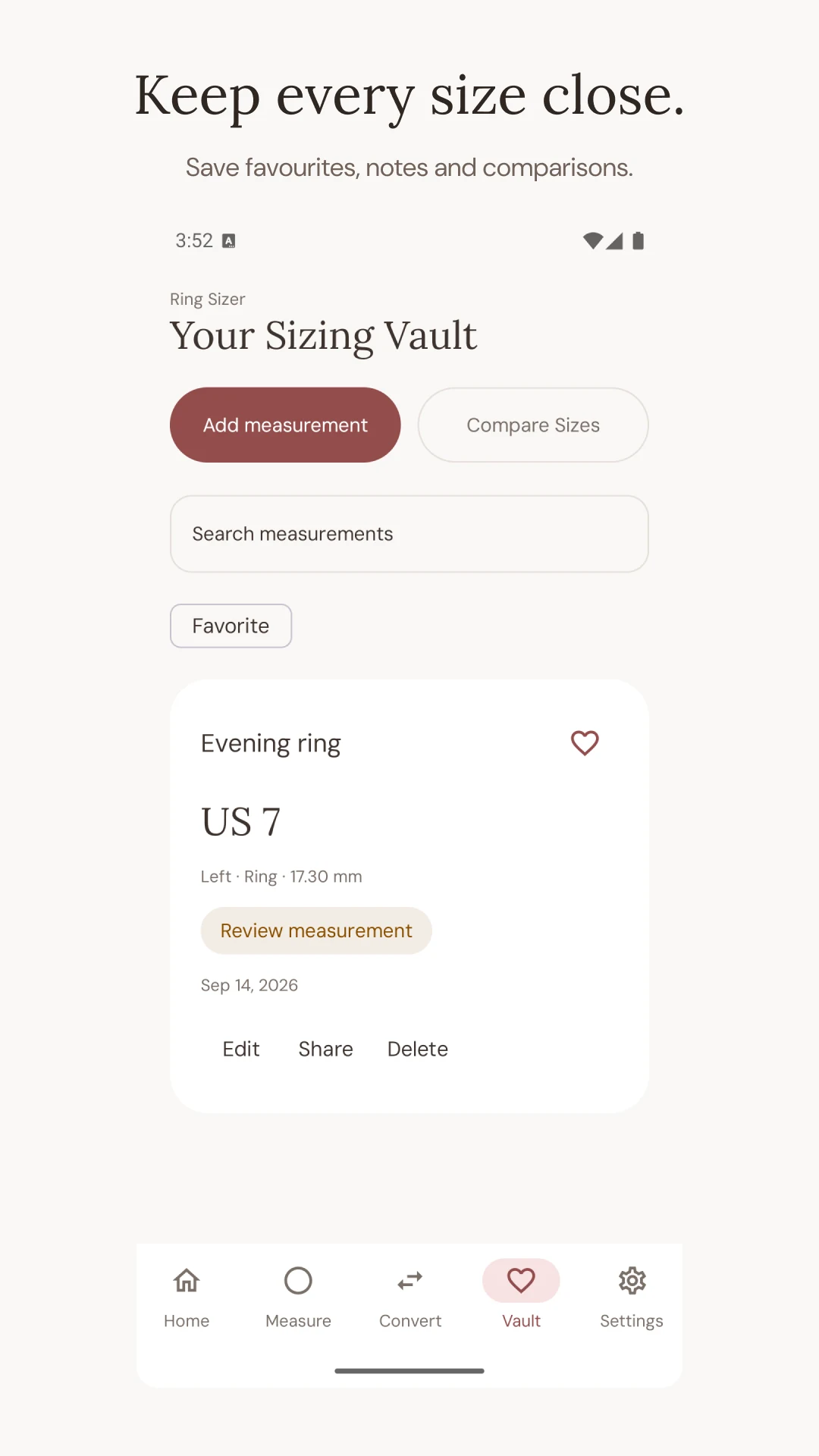
Ring Sizer’s listings describe measurements with dates and notes. Keep the original measurements and add the complete-set observations and workshop proposal. A saved conventional size should not be changed to an imagined post-solder size before a fitting has established that result. You can retain the same information in an ordinary written note if you prefer.
The real Android vault image below shows the existing record feature. It is not a repair instruction or evidence that the app inspected your rings. The app cannot assess solder compatibility, stone security or a future alteration from a saved size or generated try-on.
Official Google Play screenshots, captured in English on Android. These images are not a calibrated measuring surface. App versions and reference charts may round size labels differently; keep your raw millimetre measurement and check the seller’s chart.
At collection, repeat the agreed fit and appearance checks with the completed set. Report a new pressure point, awkward removal or unexpected alignment rather than assuming that discomfort is part of the process. The useful outcome is an arrangement you can wear and maintain, with the work and fitting decision clearly documented.