Pandora ring sizes explained: match your measurement to its chart
Use the Pandora chart linked to the product and market you are shopping in. Start with a fitting ring’s inner diameter or a finger-circumference estimate, then read the matching column. Preserve the original millimetres: a general converter and Pandora’s rounded labels can differ without either result proving the finished ring will fit.
A Pandora size chart is most useful when you know what went into it. “My ring is 17 mm” is not enough if one person means the inner opening and another has measured the outside of the metal. Establish the measurement first, then look up the retailer’s label. Do not begin with a familiar US number and assume every other column will match a general-purpose chart exactly.
This is an independent explanation published by the Ring Sizer website, not a Pandora fitting service or an endorsement by Pandora. The examples below come from Pandora’s US guide checked on 1 November 2026. Follow the product page and current guide for the country where you place the order; stock, models and instructions can change.
Start with the correct measurement column
Pandora’s US ring guide offers diameter and circumference views. Use the diameter view for the measured inner opening of a suitable round ring. Use the circumference view for an appropriately labelled circumference record. The same unit, millimetres, does not make these interchangeable inputs.
For a current fitting ring, check that it belongs to the intended finger and hand. A ring worn on your right middle finger is not a measurement of your left ring finger. Check that the opening is round and the design lets you see both inner edges. An open or distorted ring may need a different assessment rather than a circle comparison.
If you measured a finger with paper, keep that method in the record. It provides an estimate of the soft-tissue circumference, not a physical test of a finished Pandora band. The existing-ring guide and finger-measurement guide explain those separate starting points.
A small extract from the published chart
The following rows are an attributed lookup extract from the US guide, not measurements of Pandora rings by our editorial team. They illustrate why the chart name should remain attached to the answer. Read the linked original when you are ready to buy rather than treating this small extract as a replacement for its complete instructions.
| Inner diameter in Pandora’s US guide | US label | UK label | European label |
|---|---|---|---|
| 16.5 mm | 6 | L–L½ | 52 |
| 16.9 mm | 6.5 | M | 53 |
| 17.2 mm | 7 | N | 54 |
The circumference is not another independent measurement when it has been calculated from diameter. For example, a perfectly circular 17.2 mm opening is approximately 54.0 mm around. That calculation describes the example’s geometry. It does not establish the dimensions of every finished item carrying the same European label, or how that item will feel on your finger.
Why might another converter show a different label?
Reference tables do not always use the same rounded rows or increments. A US 7 row in a general cross-reference can carry a different nominal diameter or UK label from the retailer’s row. When you convert a rounded label back into millimetres, you can also get a value that differs from the measurement you originally entered.
Suppose your own opening estimate is 17.0 mm. Keep “approximately 17.0 mm, inner diameter” as the starting record. Compare it with the neighbouring rows in the target chart and ask about the sizes the particular product actually offers. Do not silently replace the measurement with 16.9 or 17.2 merely because those values appear beside available labels.
This is the practical meaning of same-size rings fitting differently. The label identifies a candidate to check. The intended ring’s width, interior and construction remain part of the fitting decision. More decimal places in an app cannot reconcile all those variables without physical information.
What changes for wide bands, open rings and stacks?
Pandora’s guide flags that wide bands can feel more snug and suggests considering a larger size. It also advises the next size up when between its sizes. Those are the retailer’s instructions, not a universal rule that should be copied to every brand or every open-ring design. Confirm which product and size increment the advice refers to.
For an open ring, establish whether the design is intended to adjust and within what limits. Do not bend a ring simply because its ends do not meet. Read the product instructions and ask the seller before treating a changed gap as a reliable fit solution. Our adjustable-ring guide covers that distinction.
For a stack, try the planned bands together in their normal order. A narrow ring worn alone does not demonstrate how a wider group will feel. Save the individual product references and the combined arrangement; the stacking guide handles that physical test in more detail than a single conversion row can.
Build a record you can show customer service
A useful note can say: “Left ring finger; current round narrow ring; inner diameter approximately 17.0 mm; checked display scale; considering this Pandora product reference; comparison with US guide not yet physically confirmed.” The value is its traceability, not the specific example number. It makes clear what the seller still needs to help you resolve.
Ring Sizer can retain measurements and notes, as described in its Android listing. Save the original value and place the retailer’s suggested label in the note. Do not overwrite a physical measurement with a chart result and lose the distinction between the two.
Official Google Play screenshots, captured in English on Android. These images are not a calibrated measuring surface. App versions and reference charts may round size labels differently; keep your raw millimetre measurement and check the seller’s chart.
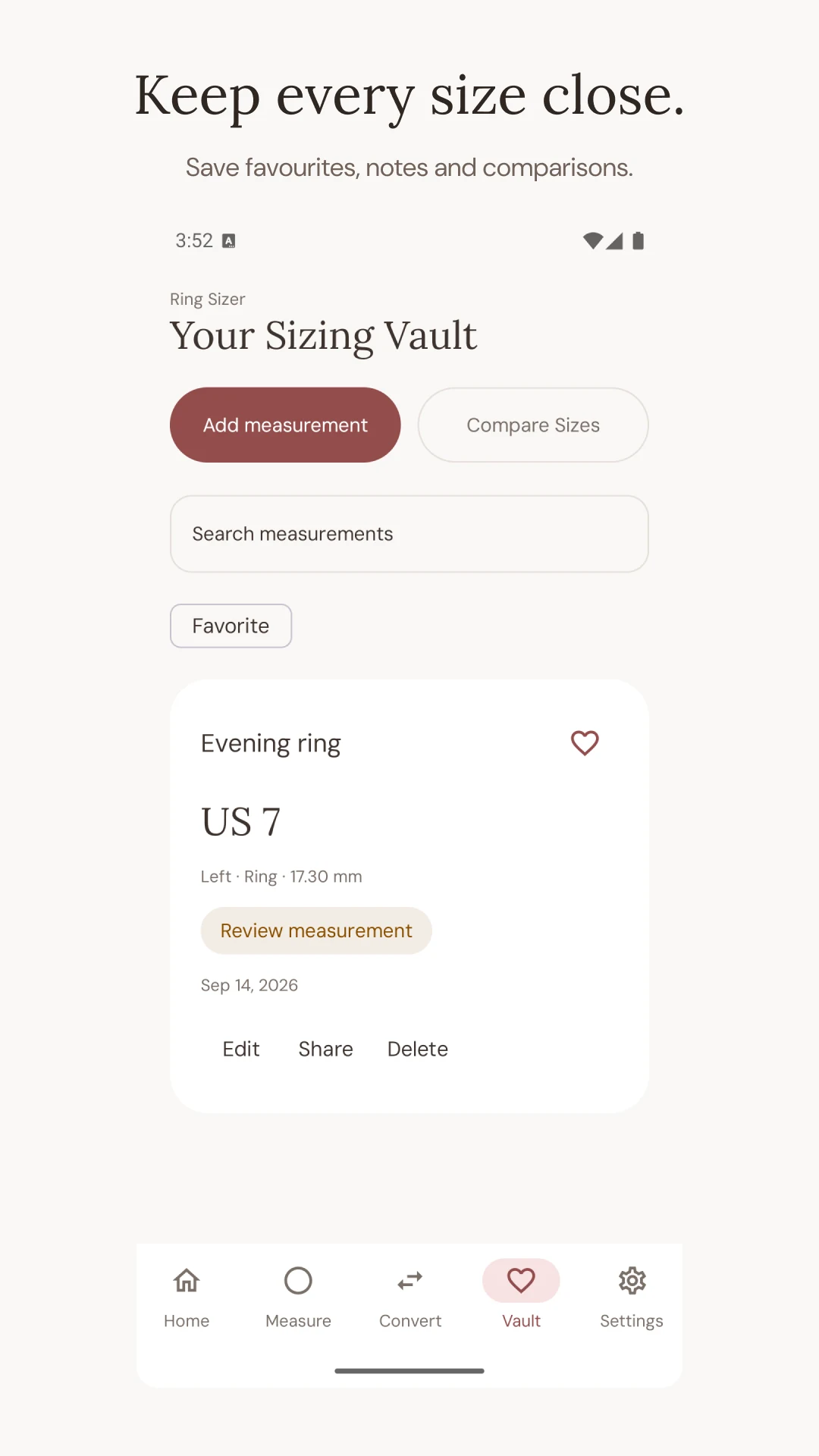
The screenshot is a real store image of the Android app. It is not a Pandora integration or a test of the illustrative 17.0 mm opening. App access and storage allowances vary by platform and offer, so check the version you install rather than assuming every feature is unlimited.
Before selecting the final size
Ask which chart applies to the exact item, which sizes are available and whether a suitable sample can be tried. If the proposed band differs substantially from your reference ring, explain that difference. Include any plan to wear several rings together rather than asking the seller to infer it from a single size number.
Check the current exchange, alteration and personalisation terms for the order. Do not assume that an open shape is adjustable, that all items can be resized or that a general return policy answers every product-specific question. A written answer tied to the product reference is more useful than an undated screenshot of a chart.
The aim is to reach a size choice with a clear chain behind it: the intended finger, a stated measurement method, original units, the appropriate retailer table and a fit check suited to the design. If one of those links is missing, resolve it before a numerical match becomes a purchase.