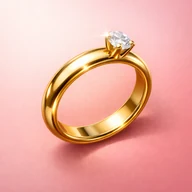
Do rings stretch over time?
Metal rings do not behave like elastic bands and do not normally loosen simply with age. A ring may become larger through intentional professional stretching or plastic deformation, while shank wear, an oval opening, a missing insert or a change in the finger can create a similar feeling. Compare physical measurements and condition before deciding whether the ring or the hand changed.
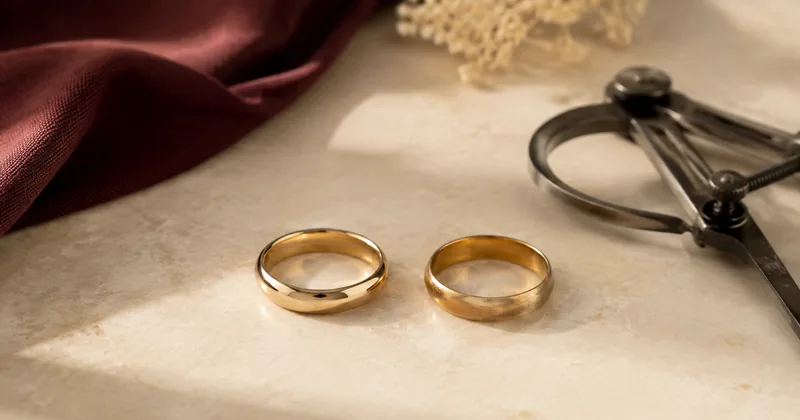
When someone asks whether rings stretch over time, “stretch” can describe several different events. A bench jeweller may intentionally enlarge a suitable ring. A force may deform a band. The inside can feel roomier after a sizing insert is lost. A worn shank can change shape. Often the metal has not enlarged at all and the finger has changed with temperature, body change or another condition.
Those causes need different responses. A loose ring is not evidence that the metal expanded, and a round number stamped on an old receipt is not a current measurement. The useful test compares the ring’s present opening and condition with an earlier reliable record, then checks the intended finger separately. This article concerns metal rings. Flexible silicone behaves differently, so material-specific detail belongs in the silicone versus metal sizing guide.
What do people mean when they say a ring has stretched?
In everyday speech, “stretched” often means only that a ring now feels loose. That observation is real, but it does not identify the cause. The ring may have a larger circumference, may have become oval, may have lost material or an internal fitting component, or may be sitting on a smaller finger. A top-heavy setting can also rotate and be described as loose even when the inside measurement remains the same.
Separate the symptom from the mechanism. Record when the looseness appears, which finger and hand are involved, whether the ring crosses the knuckle differently, and whether another ring on the same finger changed too. Then inspect the object for shape, wear and missing parts. If every ring on that finger feels different, the hand deserves attention. If only one ring changed, its condition deserves attention. The ring-spinning guide provides a useful diagnostic path when rotation, rather than loss over the knuckle, is the main complaint.
Can a solid metal band enlarge during ordinary wear?
A metal band is not an elastic loop that repeatedly expands around a finger and returns. Metal can deform when sufficient force is applied, and jewellery alloys differ in their mechanical response, but ordinary age alone does not supply a predictable size increase. A ring that has been crushed, caught, bent or worked at the bench may undergo permanent shape change. Without a previous measurement, appearance alone cannot show how much its inner circumference changed.
The Canadian Conservation Institute’s guidance on metal objects explains that pressure can deform a metal’s grain structure and that physical forces can cause dents, distortion or breakage. It also notes that softer metals are especially vulnerable to scratches and abrasion. That supports a limited conclusion: forces and material loss can change a ring. It does not support a schedule such as “one size every ten years.” The alloy, construction, wear pattern, forces and prior work must be inspected on the actual piece.
How can shank wear make a ring seem larger?
The bottom of a shank repeatedly contacts tools, handles and surfaces. Over time it may become thinner or flatter, particularly if it began delicate or has been polished many times. Material loss is not the same mechanism as stretching, yet a worn section can become easier to distort and may alter how the ring sits. A very thin lower shank can also make the decorative top feel less stable, which a wearer may interpret as an oversized fit.
Compare thickness around the full band rather than looking only at the opening. GIA’s vintage-ring buying guidance warns that years of wear can leave prongs weak and the back of a shank too thin, sometimes requiring shank replacement. A professional should check a thin area, old join and setting together. Adding more force to test whether the ring “stretches” can worsen the condition. The vintage sizing checklist explains how to document two axes, shank condition and previous repairs before alteration.
How does oval deformation change the way a ring fits?
An oval opening has a long axis and a short axis. It can feel loose in one direction, resist at another, rotate under a setting, or pass the knuckle differently depending on orientation. A ruler placed across the longest span may suggest that the ring grew, even if the circumference changed less than that single diameter implies. Conversely, measuring only the short axis may make the ring appear smaller than its wearable path.
Measure both internal axes gently and record them separately. Do not force the ring onto a round mandrel just to obtain a tidy answer, because that action can change the evidence you are trying to observe. A jeweller can assess whether the oval is intentional, a benign feature of wear or a sign that the shank or setting needs work. If the ring is restored to round, take a new measurement afterward. The normal existing-ring measurement method is reliable for a sound round opening; the two-axis record is what prevents an oval ring from being reduced to a misleading single diameter.
Can a lost insert or sizing aid explain the looseness?
Yes. A ring can contain sizing beads, a spring insert, an inner liner, a removable guard or another component that reduces effective space or stabilises the band. If that component loosens, breaks or is removed, the metal ring may feel larger even though the main shank has not changed size. A guard added temporarily can also compress, shift or detach. The wearer may remember only that “the ring used to fit.”
Inspect the interior for attachment points, polished patches, solder marks or differences in colour, but do not pull at a surviving component. Compare older photographs, repair invoices and the jeweller’s description. If a part is missing, identify the system before replacing it; different mechanisms place different loads on the shank and may not suit every setting. A prominent knuckle often motivates these devices because a ring large enough to cross the joint is loose at the base. The large-knuckle guide separates those two measurements so a replacement solution can address the actual fit problem.
How can a changing finger look like a stretching ring?
Finger size can vary over a day and across longer periods. Temperature, activity, pregnancy, weight change, injury, joint shape and health-related swelling can all affect fit, with no universal direction or fixed correction that applies to everyone. A ring that becomes loose during gradual weight loss may be physically unchanged. A ring that becomes tight in warm conditions did not necessarily shrink.
Repeat the finger measurement under comfortable, ordinary conditions and note the time, method and anything unusual. Compare other rings used on the same finger and, if possible, compare the metal ring’s inner dimensions with a prior professional record. The weight-change article explains why there is no pounds-to-ring-size formula, while the temperature guide shows why a single hot or cold reading is weak evidence. If fit changed suddenly or swelling is severe, painful, red, hot or unexplained, stop treating it as a jewellery puzzle. The NHS guidance on swollen hands lists those features among reasons to seek urgent medical advice.
What is intentional professional ring stretching?
“Stretching” is also a bench term for deliberately enlarging certain suitable bands by controlled working. It is one of several professional sizing approaches, alongside adding or removing metal, replacing part of a shank or using a fitted mechanism. Suitability depends on the alloy, current condition, profile, taper, seams, setting, decoration and the amount of change required. There is no responsible universal range for all rings.
Stuller’s technical ring-sizing overview describes specialist stretching and swaging methods for restricted types of plain bands and warns that uncontrolled movement can deform or torque other constructions. That is bench guidance, not a do-it-yourself instruction. Do not hammer a ring, drive it down a mandrel or use a consumer stretcher without a qualified assessment. Before approving work, ask which method the jeweller proposes, why it suits this ring, how the setting and marks will be protected, and what finished measurements will be recorded. The general resizing guide covers the questions without promising that a material or design can always be altered.
How can you compare the ring safely at home?
Start with a visual record on a padded, well-lit surface. Photograph the ring from above and both sides. Check whether it rocks, whether the opening looks oval, whether the bottom is thin, and whether any internal component appears absent. If the ring is sound and round, compare its inside edge with a calibrated on-screen circle or measure the inside diameter without clamping or forcing the band. Record the method and raw millimetres.
Next measure the intended finger more than once under ordinary conditions. Do not infer ring change from a conversion label alone, because retailer charts can round the same physical measurement differently. If an old receipt gives only “size 7,” ask whether the seller or repairer recorded a diameter or circumference as well. The fit checklist helps distinguish secure resistance at the knuckle from binding or easy loss. Stop the home check if a stone moves, a crack opens, a sharp edge appears or the ring needs force to pass the joint.
When should a jeweller inspect a ring that feels different?
Arrange an inspection when the opening is visibly oval, the shank is thin, a join or crack is apparent, a stone or prong moves, an insert is missing, or the ring changed after an impact. An inspection is also appropriate before altering a valuable, engraved, stone-set or inherited ring. Bring old measurements, photographs, invoices and the current finger record so the professional can compare evidence rather than reconstructing history from memory.
Ask for the present size, two-axis dimensions if relevant, shank thickness, condition findings and recommended method in writing. After any work, request the finished measurements and recheck the setting. GIA’s care guidance also cautions that chemicals and unsuitable cleaning methods can harm metals or gems, so cleaning and repair should be planned together when materials are uncertain. If the ring is simply the wrong size for the current finger, the wrong-fit options compare return, professional alteration and temporary approaches. The answer should follow the measured cause, not the convenient word “stretch.”