Cartier LOVE vs Trinity ring sizing: what should you check?
Do not apply one automatic size adjustment to every LOVE or Trinity ring. Identify the exact model and reference, consult its current Cartier guidance and try that design where possible. A remembered size from a different ring, or an older Trinity instruction copied without its model exception, is not enough to choose the new ring.
The question “Should I take the same size in LOVE and Trinity?” needs more detail than the two collection names. Specify which ring within each collection, which hand and finger, and whether your previous size came from a physical fitting or a conversion table. Without those details, one person’s advice to size down can contradict another’s advice to keep the same number.
This is an independent planning guide from the publisher of Ring Sizer, with no Cartier affiliation. It is not a boutique fitting, authentication service or wearer trial. The focus is how to ask a precise sizing question and preserve the evidence behind the answer. It does not publish a new universal Cartier conversion or promise that an app can select the finished size.
Identify the actual rings before comparing labels
Write the product reference beside the collection name. Include the model description, material, whether stones run around the band and whether the piece is new or pre-owned. Those details help a retailer distinguish the item you mean from a visually similar one in another version. A photograph captioned only “Trinity” may omit the detail that changes the advice.
For a concrete product-description example, Selfridges lists a Trinity medium model with three interlinked bands and a stated width. Ask what a listed width describes: one band, the assembled design, or another dimension. Do not add or multiply a catalogue measurement and present it as a measured wearing width.
For a physical comparison, describe the construction too. A solid band and a set of linked moving bands should not be treated as interchangeable samples. Look at how the ring goes on, how its parts settle and how it feels when you gently close your hand. Let the retailer show the intended wearing method for that reference rather than forcing a configuration from a photo.
A reference number is a communication aid, not proof of authenticity. If buying second-hand, keep the seller’s description, condition information and service history separate from your measurement record. Sizing a piece does not authenticate it or establish what work it has received.
Why older Trinity instructions need their context
A published Cartier ring-sizing PDF contains Trinity-specific instructions and exceptions tied to named model references. It is a legacy document, not confirmation that the same instruction applies to every ring sold today. That distinction matters whenever a screenshot circulates without the model notes or date.
Do not reduce a qualified instruction to “all Trinity rings need one size smaller” or “always subtract two”. First establish which chart supplied the starting number, which model the note describes and whether the current seller confirms it for the item in your order. A correction relative to one reference chart cannot safely be repeated after another conversion.
When current instructions are unavailable, leave the proposed size unconfirmed and ask Cartier or the authorised seller for the model-specific answer. An honest pending field is more useful than an exact-looking rule assembled from mismatched generations of buying advice.
Keep conversion and fit as separate steps
A general converter can help you understand a measurement in another naming system. It cannot establish that two ring constructions occupy or move around the finger in the same way. Avoid treating a size number as a complete description of pressure, joint passage or how a linked design settles during movement.
Keep the measured circumference or inner diameter as its own field. Next to it, write the reference-table label and then the retailer’s confirmed product size. If those labels differ, you can explain why without changing the original measurement. The comfort-fit comparison discusses another reason labels alone do not determine the wearing experience.
For a hypothetical record, “finger circumference estimate approximately 54 mm” is not the same statement as “Cartier size 54 confirmed”. The first describes an input and method. The second would describe a product decision after the relevant fitting advice. Do not use an equals sign between them before the seller has supplied the missing context.
How to compare two candidates at a fitting
Use the intended finger and keep the conditions reasonably comparable. Ask to try the exact reference or a sample the retailer says represents it. Explain whether you will wear the ring alone or alongside another band. A sample that works by itself may not settle the combined arrangement you actually plan to wear.
Observe putting it on, resting at the base, ordinary hand movement and removal. Say where it feels different rather than deciding that the whole ring is simply too big or too small. For example, the joint may be the limiting point even when the resting position feels loose. Do not solve that conflict by forcing a smaller sample over the joint.
Ask the fitter to record the product reference, proposed size and reason for the choice. If two candidates remain plausible, discuss another ordinary-condition check. Our wide-band guide covers the importance of a representative sample without inventing a universal half-size addition for every broad ring.
A comparison worksheet to take with you
Make two columns before the appointment. Leave uncertain entries blank rather than filling them with a rule from someone else’s purchase. This example worksheet does not recommend actual sizes; it gives each decision an owner and a way to be checked later.
| Detail | LOVE candidate | Trinity candidate |
|---|---|---|
| Exact product reference | Record it | Record it |
| Intended hand and finger | Record it | Record it |
| Current chart and model note | Link or dated copy | Link or dated copy |
| Sample actually tried | Identify it | Identify it |
| Fit alone and with other rings | Note both if relevant | Note both if relevant |
| Seller-confirmed size | Leave pending until confirmed | Leave pending until confirmed |
This prevents a meaningful difference from disappearing into a memory such as “I am usually 52”. It also helps a second adviser understand the first fitting without assuming that every number in your notes was produced by the same method or chart.
Where a saved app record helps
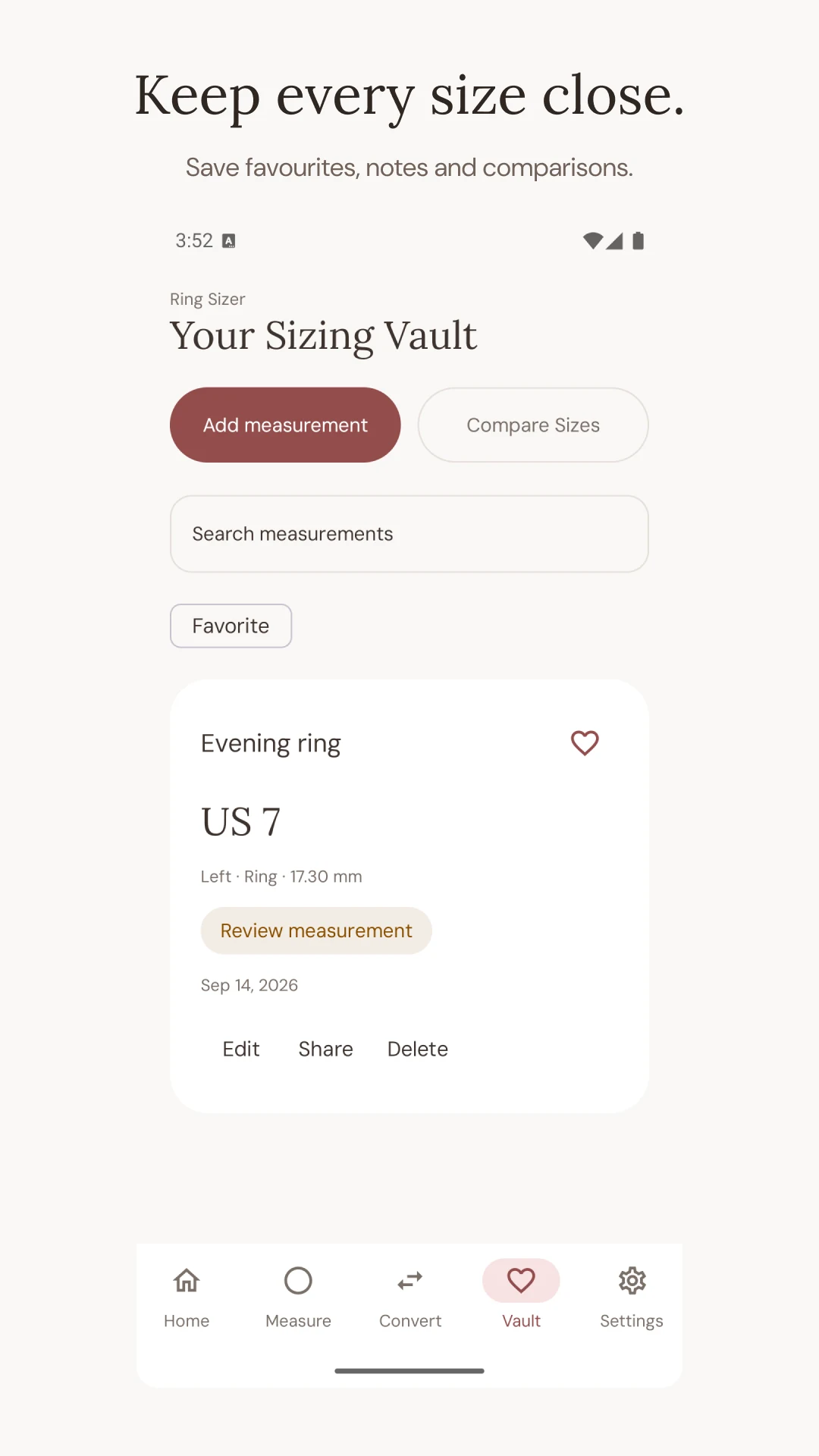
Ring Sizer can keep a measurement, method and notes together, as described in its iPhone listing. Use the note for the product reference, fitting date and retailer response. Preserve any conventional measurement separately from a collection-specific instruction. The app has no verified automatic LOVE-to-Trinity fitting calculation.
If your reference is an existing ring, record which finger it currently fits and whether it has been altered. A saved diameter can be useful background, but it does not reproduce the wearing mechanics of another design. The same-size comparison explains why the next step remains a representative physical check.
Official Google Play screenshots, captured in English on Android. These images are not a calibrated measuring surface. App versions and reference charts may round size labels differently; keep your raw millimetre measurement and check the seller’s chart.
Before purchase, ask about the item’s exchange and service options, especially before engraving or alteration. Keep any answer tied to the actual order. A chart can suggest candidates; a model-specific fitting and a clear recovery route make that suggestion useful for an expensive ring.