Samsung Galaxy Ring vs Oura sizing: can you reuse the same size?
Do not assume the same number fits across Samsung Galaxy Ring and Oura. Use the sizing kit specified for the exact brand and model you are buying. Oura also distinguishes kits by generation. Record each tested result separately; an ordinary jewellery-size conversion is not a verified conversion between smart-ring products.
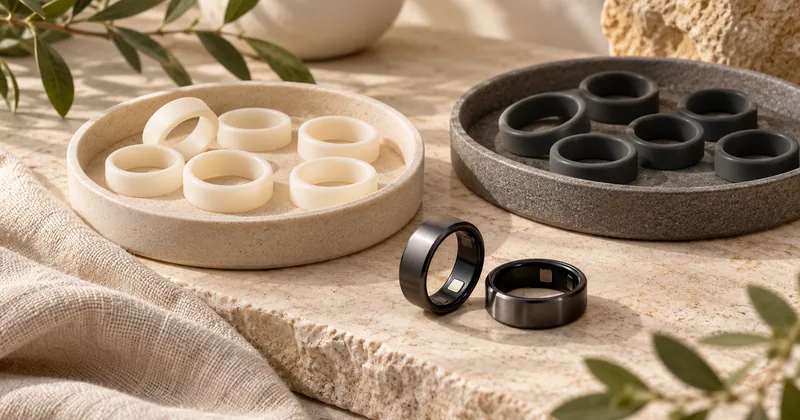
You may already know your Oura size and want to order a Galaxy Ring without waiting for another kit. Or you may be comparing products and hoping one set of samples will settle both purchases. The tempting shortcut is to copy the number. The useful comparison is whether the exact sample represents the construction of the ring you intend to buy.
This article compares published fitting instructions, checked on 1 November 2026. It is not a wearer trial, sensor-performance test or claim that one manufacturer measures more accurately. We publish the Ring Sizer app, which can help keep measurement notes. It is not affiliated with Samsung or Oura and does not supply either manufacturer’s sizing kit.
What do the manufacturers actually recommend?
Samsung’s US sizing instructions recommend its Galaxy Ring kit because the sensors can make your usual jewellery size a poor guide. Samsung asks readers to test a sample for more than 24 hours, including sleep, with the orientation line facing the palm. Confirm the instructions for your market and product.
Oura’s current sizing guidance says its whole-number sizes differ from standard US jewellery sizes and identifies kits by generation. It asks readers to wear the appropriate sample for at least 24 hours. In the version checked, Ring 5 and Ring 4 have separate kit descriptions.
These instructions support one clear conclusion: keep the original product context attached to a size. They do not establish a numerical conversion from a Samsung sample to an Oura sample, or from either to a conventional ring. An identical label can be a coincidence rather than permission to reuse the result.
Check the kit identity before trying any sizes
Read the box, insert and product page. Write down the manufacturer, ring model or generation, kit identity and source. This matters when a kit is borrowed, bought second-hand or stored without its original packaging. A collection of loose plastic samples can look convincing while leaving the most important question unanswered.
Ask the seller whether that exact kit is accepted for the product reference in your order. If the answer is uncertain, obtain the correct kit rather than inferring compatibility from colour, the largest sample or a forum photograph. Product instructions can change, and a familiar-looking sample does not establish its internal dimensions.
| Information to retain | Example format, not a fit result |
|---|---|
| Product | Brand plus exact model or generation |
| Kit | Label on the box or supplier’s confirmation |
| Wearing position | Left index finger, for example |
| Trial | Dates, conditions and sample label |
| Decision | Keep testing, manufacturer advice, or size confirmed |
Compare the intended finger, not your whole hand
Trying one product on the left index finger and another on the right ring finger can be useful if those are the positions you prefer. It is not a controlled comparison of product sizes. You changed both the ring and the finger. Record that distinction before concluding that one brand runs larger or smaller.
Use separate trials on the actual candidate fingers, following each manufacturer’s permitted positions and orientation. Keep observations about movement, comfort and removal. If you decide to change hands later, treat the new position as another fit check rather than moving the previous conclusion unchanged.
The left-versus-right-hand guide explains why a fixed dominant-hand correction is unreliable. Our general smart-ring guide covers the wider fitting process. This comparison adds the product and kit identity that can otherwise disappear when someone writes down only “size 9”.
A worked record that avoids a false conversion
Imagine a reader has previously worn an Oura sample labelled 9 and is now considering a Galaxy Ring. The defensible starting note is “Oura, model recorded separately, sample 9, right index”. It is not “US 9” unless that is independently known for conventional jewellery. There is no arithmetic step that turns the old sample label into an approved Galaxy order.
Create a second record for the Samsung trial. If its eventual label is also 9, keep two records anyway. That agreement belongs to two specific products and that person’s tested position. It is not a conversion table for other buyers. If the labels differ, the old record remains valid for its original context.
This is a hypothetical example, not a published test of either size. Its purpose is to show how to preserve evidence without pretending that a sample label measures a universal physical quantity. The most valuable note may be the kit model, not another decimal place.
Why a conventional ring converter cannot settle the choice
Our converter maps ordinary jewellery reference sizes and physical dimensions. It has no verified Samsung-to-Oura product table. Do not select US for a smart-ring label and interpret the resulting millimetres as a manufacturer-confirmed inner opening. You would have changed an opaque product label into a physical measurement without measuring it.
Similarly, a circle matching the visible opening cannot reproduce every detail of a smart ring’s interior or prove the required sensor contact. A photo preview is useful for appearance, but generated pixels do not demonstrate a functioning sensor fit. Keep style, geometry and the manufacturer’s fitting procedure as separate questions.
If a completed ring differs from the sample experience, contact the manufacturer or authorised seller with your records. Do not sand, heat, stretch or install an improvised insert to make the device resemble another product’s fit. Modification introduces a different problem and does not validate the original sizing assumption.
How can Ring Sizer help without choosing the smart-ring size?
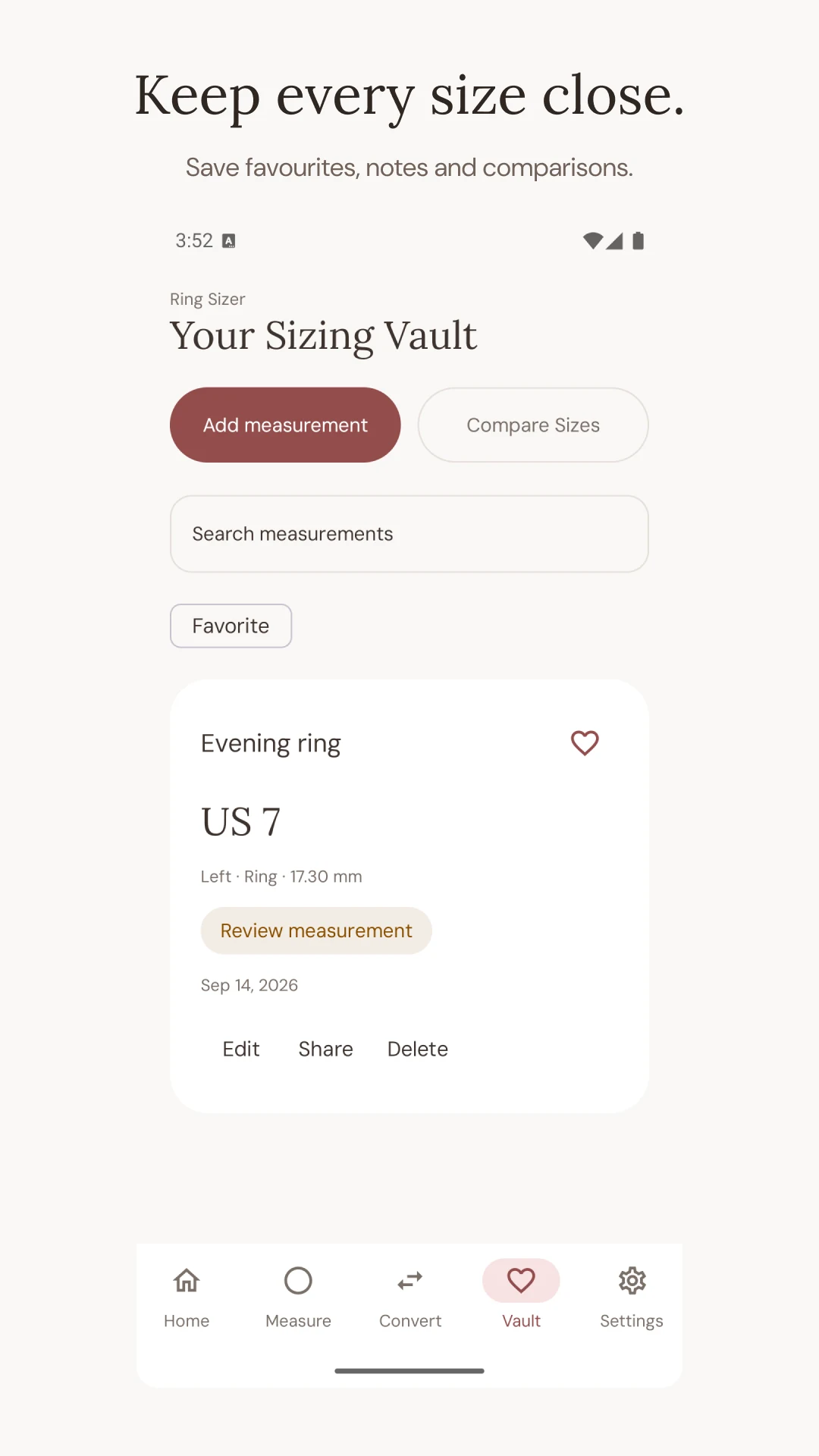
Use its notes to retain the product, hand, finger and date beside any ordinary measurement you have made. Do not overwrite a physical diameter with a proprietary sample number. If a save form requires a conventional sizing system, put the smart-ring label in the note and keep the underlying measurement field true to what it describes.
The Android store description confirms saved measurements with notes. The real Android vault screenshot below illustrates that record-keeping feature; it does not show a manufacturer integration, a tested smart-ring cohort or an automatic cross-brand conversion.
Official Google Play screenshots, captured in English on Android. These images are not a calibrated measuring surface. App versions and reference charts may round size labels differently; keep your raw millimetre measurement and check the seller’s chart.
Before confirming an order, match the product reference to the kit you used, review the full trial notes and check the seller’s current exchange procedure. A shared number is convenient to remember. A record tied to the correct kit is more useful when a purchase needs explaining.