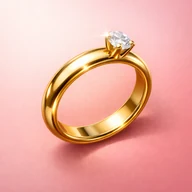
Is ring size stamped inside a ring? What the marks mean
A stamp is not automatically a ring size. Marks such as 925, 585, 750, 14K and 18K identify metal fineness in the relevant marking systems, while other marks can identify a maker or assay office. Some makers may add a size, so verify the mark with the maker or seller and measure the ring’s current opening.
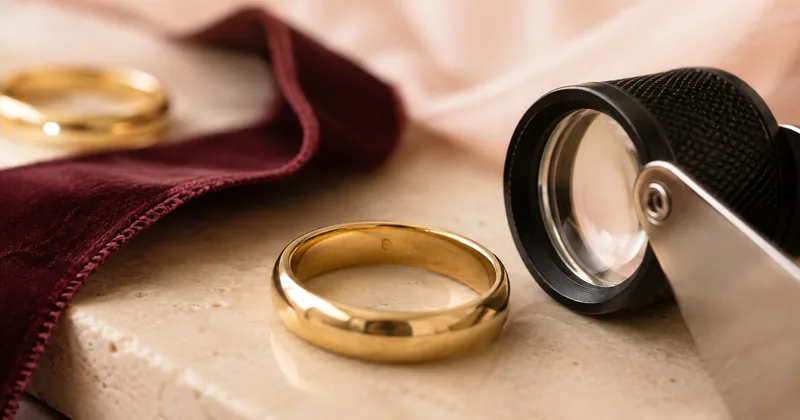
A stamp inside a ring is not automatically its size. In the relevant marking systems, 925, 585, 750, 14K, and 18K describe precious-metal fineness. Other letters or symbols can identify a maker, sponsor, assay office, date, design, patent, or inventory record. A manufacturer may also add a size, but a bare number does not prove that purpose.
The safe sequence is to photograph the complete group of marks, keep the country and seller context, and ask a qualified jeweller or the original maker to interpret them. Measure the actual ring separately. A stamp can survive resizing, become partly erased, or simply resemble a regional size code by coincidence.
Does a number inside a ring prove its size?
No. A number needs a documented marking system and context before it can be interpreted. UK hallmarking guidance defines millesimal numbers as metal-fineness information, and US consumer guidance describes karat and silver-quality marks. A manufacturer can separately place an order size or model code inside a ring. The observer cannot tell which function an unexplained number has merely because it resembles a familiar size label.
Context controls the interpretation. Read all adjacent symbols, not one number in isolation. The shape around a number, nearby initials, and the country of sale may be part of a complete hallmark. The UK government’s practical hallmarking guidance explains that a complete UK hallmark has a sponsor’s mark, a metal-and-fineness mark, and an assay office mark. That group is consumer-protection information, not a size specification.
If an invoice or manufacturer record says a particular stamp is the size, retain that evidence. Without it, treat the mark as unidentified and use a physical sizing method.
What do 925, 585 and 750 mean inside a ring?
In official UK hallmarking material, these are millesimal fineness numbers: they express precious- metal content in parts per thousand. In that notation, 925 indicates 925 parts of the stated precious metal per thousand parts of alloy and is a recognised sterling-silver standard. The official guidance also lists recognised gold fineness values that include 375, 585, and 750. None of those numbers states the ring’s inner diameter or circumference.
The surrounding marks matter. UK guidance says the shape enclosing the fineness number indicates the type of metal, and the complete hallmark also identifies the sponsor and assay office. The FTC’s US consumer advice for platinum, gold and silver likewise explains that silver products may be marked 925 and describes karat quality marks for gold. The two regimes are not identical, which is another reason not to interpret a stamp without country context.
Do not perform an acid, scratch, or heat test at home on valuable jewellery. A stamp is a clue, not proof of current condition or authenticity. Ask a qualified professional to test the metal when the result affects value, repair, or sale.
Are 10K, 14K, 18K and 24K ring sizes?
No. In ordinary jewellery marking, those are karat descriptions of gold content, not finger sizes. The karat system divides the alloy description into 24 parts: for example, an 18K description means 18 of those 24 parts are gold. It says nothing about whether the ring will fit a particular finger. The FTC consumer guidance explains this distinction and advises shoppers to look for the company name or US registered trademark associated with a gold quality mark.
Do not confuse a trailing letter with a UK ring-size letter. The “K” in 14K belongs to the gold quality notation. A standalone letter elsewhere in the mark group might be a sponsor initial, date letter, assay symbol, model code, or potentially a size, depending on the maker. Its location alone does not settle the question.
When shopping second-hand, request the listing’s physical inside measurement even if the title says “14K size 7.” Those are two separate claims: material and fit. The online buying checklist helps you ask for both in writing before the return period becomes important.
Can a letter stamped inside be a UK ring size?
It can be, but it can also mean several other things. UK ring sizes use letters and half-step notations, while UK hallmarks include a sponsor’s mark and may include an optional date letter. Initials can identify a maker or sponsor. A single stamped letter therefore cannot be labelled as a ring size without supporting evidence from the manufacturer, invoice, or a physical measurement.
The UK government’s hallmark summary states that the date letter is optional and changes by year, while the sponsor mark uses registered letters. It also explains that the hallmark works as a set of component marks. Compare the entire stamp group with an official assay-office key rather than matching one letter in a search result.
If the seller claims the letter is the size, ask which UK scale and whether the ring has since been altered. Then compare it with an actual measurement through the US-to-UK ring-size guide. A size conversion can support the seller’s explanation, but it should not replace checking the finished opening.
What other marks can appear inside a ring?
Possible marks include a maker or sponsor identifier, an assay-office symbol, an optional date mark, a convention mark, a metal or plating description, a trademark, a model or stock code, a patent reference, a personal engraving, and repair marks. A stone weight or production code may also appear on some pieces. Practices differ by maker and market, so this is a list of possibilities, not a decoder for every ring.
In the UK, a Convention mark may be legally recognised under the international hallmarking system, and the official guidance distinguishes compulsory marks from optional traditional fineness symbols and date letters. In the United States, the FTC Jewelry Guides overview focuses on truthful representation of metallic content and other product attributes. Neither source says that an unidentified interior number should be assumed to be the ring size.
Engravings can also be sentimental rather than technical. Before polishing, resizing, or attempting to clean a faint mark, photograph it in diffuse light. A jeweller can determine whether the mark is important to provenance or likely to be damaged by work.
Why can the stamped size be wrong now?
Even when a maker originally stamped the size, the ring may no longer match it. A jeweller may have resized the shank without changing the interior mark. Wear can thin the band, an impact can make the opening oval, and a sizing insert or beads can reduce the usable space. A second-hand seller may also copy an old receipt rather than measure the current object.
That does not automatically make the ring counterfeit. It means a historical mark and a current measurement answer different questions. Look for solder joins, changes in colour, interrupted patterns, or nearby repair marks, but do not diagnose metalwork from a photograph alone. A qualified jeweller can inspect the shank and setting safely.
The can-a-ring-be-resized guide explains why construction and stone placement affect alteration. If a stamp is part of a hallmark or meaningful engraving, ask how a proposed resize would preserve it before authorising work.
How do you identify a ring stamp safely?
Start with a clean, non-destructive record. Photograph the whole ring, then the complete line of marks under soft light from several angles. Note the country of purchase, approximate age if known, seller, metal description, original packaging, and every character exactly as seen. Do not trace a faint mark with a pin, file the surface, or use an online “acid test” that could damage the piece or expose you to chemicals.
Compare the group with the official hallmark authority for the relevant country. In the UK, use the British Hallmarking Council material or an Assay Office. In the US, use the FTC consumer guidance for quality-mark terminology, then contact the named maker or a credentialed appraiser for an identification that affects value. Online image matching can generate leads but cannot verify the metal or history.
Keep evidence boundaries clear. A readable 925 can support an interpretation about the stated silver fineness convention; it does not prove who made the ring, when it was made, whether it has been plated, or what size it is today.
How do you measure the ring’s actual size?
For a round ring that fits well, a jeweller can place it on an appropriate ring mandrel and read the defined contact point. At home, you can measure the inside diameter across the widest clear opening with suitable calipers, taking care not to include the metal walls. Repeat across more than one direction. If the values disagree, the ring may be oval and a single diameter conversion will be unreliable.
GIA’s ring and finger sizing benchmark notes that the interior must be perfectly round for an inside-measurement chart method and gives different reading guidance for tapered and convex interiors. Use the existing-ring guide for a step-by-step process, or take the ring to a jeweller when it has a protruding stone, an open shank, a broad taper, or delicate metalwork.
Record the inside millimetres and the system used for any converted label. Do not engrave or resize the new purchase solely from the old ring’s stamp.
What should you ask a seller about an interior mark?
Ask the seller to separate each claim. What metal or fineness does the mark indicate? Which maker, assay office, or authority supports that interpretation? Is any character intended to be the ring size? Which sizing system is it, what physical opening does it correspond to, and has the ring been resized? Request a current straight-on inside measurement and the return conditions in writing.
For a precious-metal purchase, check the consumer rules that apply where the seller operates. UK government guidance says qualifying items sold as gold, silver, platinum, or palladium above specified exemption weights require a legally recognised hallmark. Rules and thresholds differ elsewhere, so do not import one country’s checklist into every transaction.
If the seller cannot explain a mark, describe it as unidentified rather than filling the gap with a confident guess. A fair listing can say “interior mark appears to read X; metal and size not independently verified.” That is better evidence than turning a possible stock code into a false purity or size claim.
What is the reliable rule for stamps and ring size?
Treat the interior stamp and the current fit as separate investigations. Use official hallmark or consumer guidance to interpret metal-quality marks, maker symbols, and assay information. Use a physical gauge, mandrel, or measured inside opening to determine size. Only call a character a size when the maker’s documentation or a reliable order record identifies it as one.
The ring-size chart can translate a verified physical measurement, and the ring sizing kit guide explains how to obtain a finger or ring result with the correct tool. Neither can authenticate jewellery, while a hallmark reference cannot establish current fit. Keeping those jobs separate prevents a category error.
A number inside a ring may be valuable information, but its meaning is not self-evident. Confirm what the mark was designed to report before using it for a purchase, valuation, repair, or size decision.